September 2026

All disease sites

27 of 27 trials

Reset

Heme-Onc

PARADIGM

NCT04801797

Phase 2Practice-changingMed onc

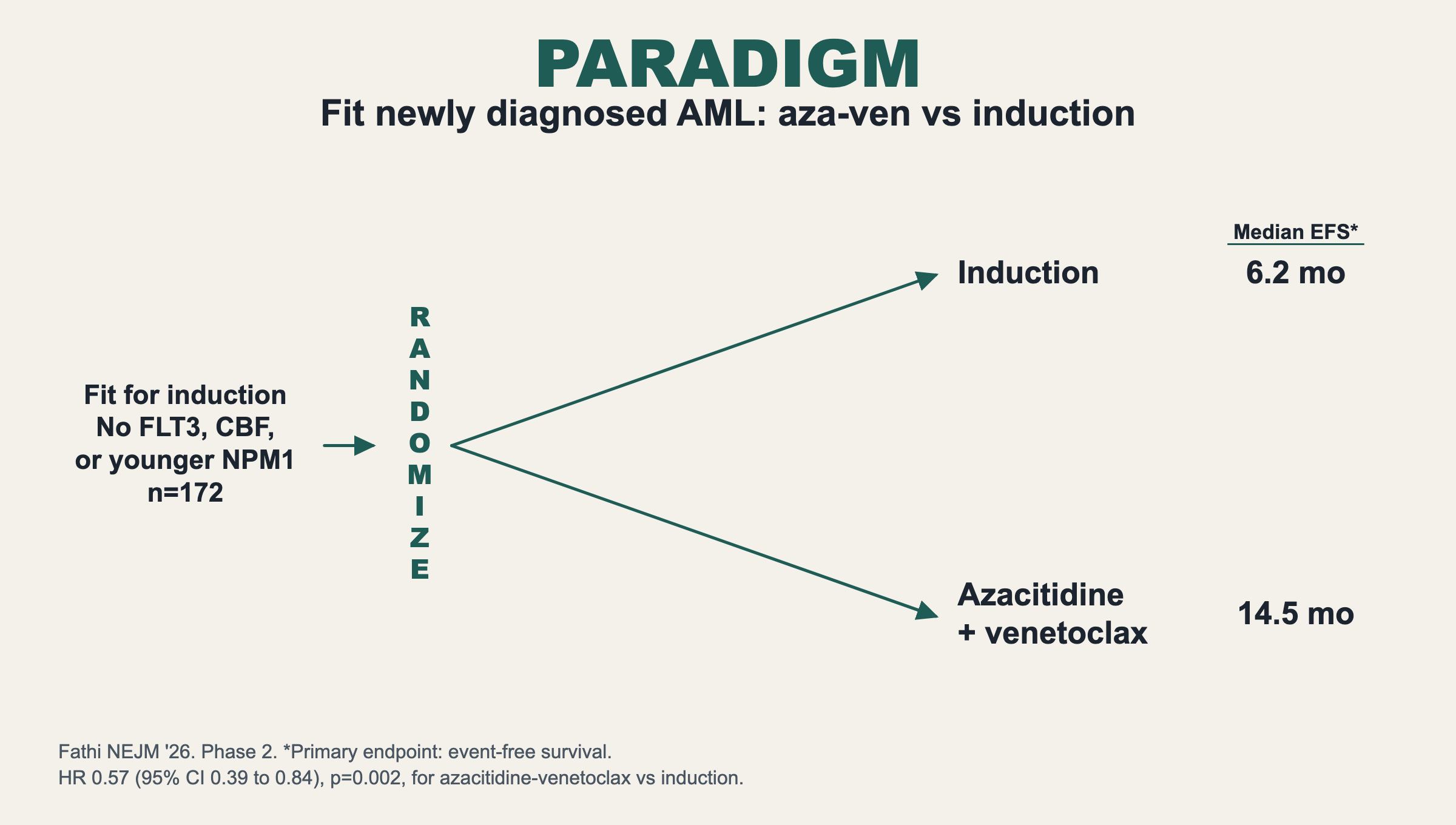
PARADIGM. Fit newly diagnosed AML: aza-ven vs induction

Population. Newly diagnosed fit adults with AML, excluding FLT3, core-binding factor, and younger NPM1-mutated disease

Arms. Induction chemotherapy vs Azacitidine plus venetoclax

Endpoint: Event-free survival

Phase 2, n=172. Event-free survival was 6.2 months with induction and 14.5 months with azacitidine-venetoclax (HR 0.57, 95% CI 0.39 to 0.84, p=0.002). Grade 3 or higher infection was 41% vs 28%.

Takeaway. A randomized signal that azacitidine-venetoclax can beat intensive induction on event-free survival in fit adults, still phase 2 rather than a registrational phase 3. A systemic induction choice for fit adults with AML.
PERSEUS

NCT03710603

Phase 3Practice-informingMed onc

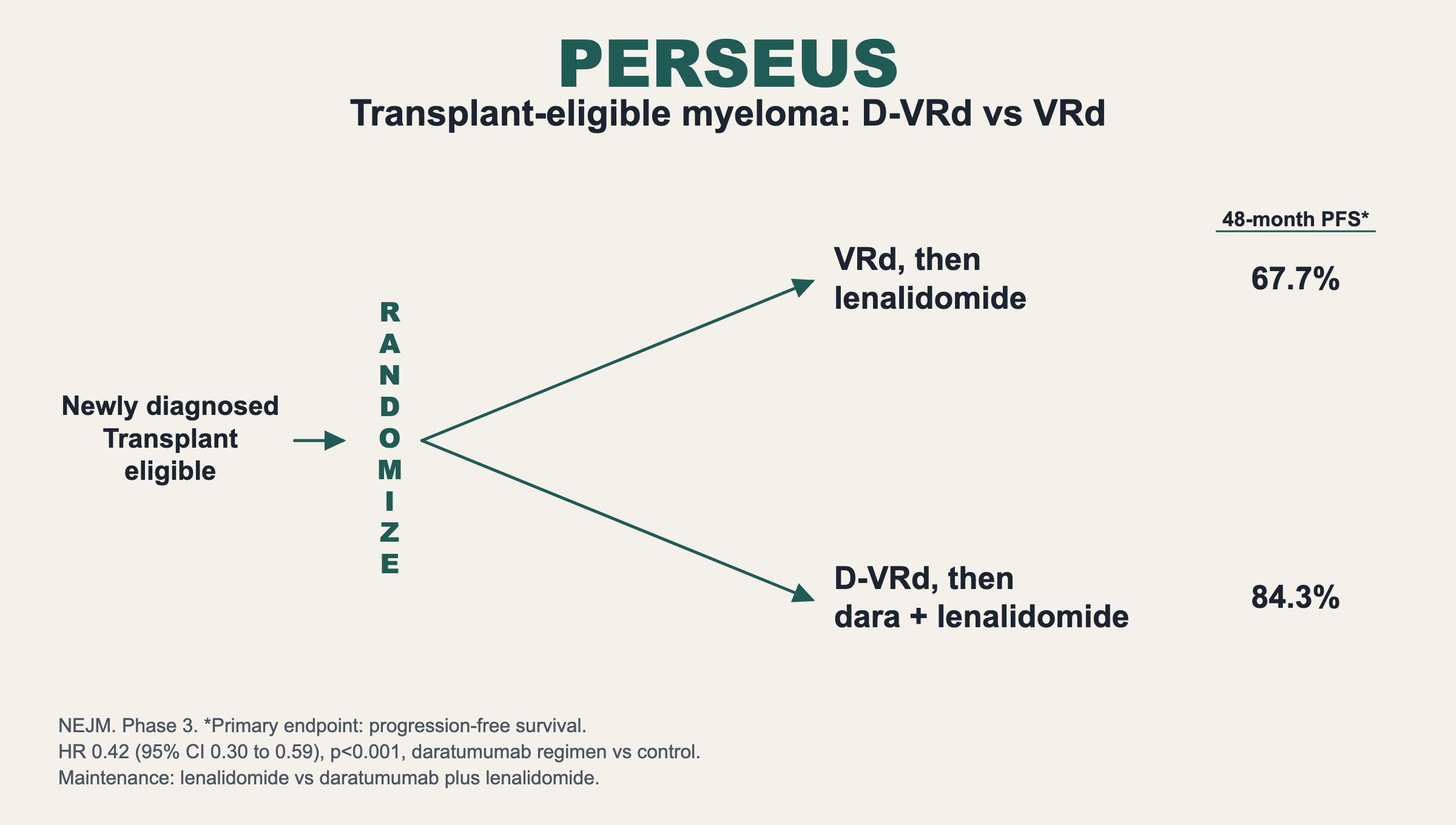
PERSEUS. Transplant-eligible myeloma: D-VRd vs VRd

Population. Transplant-eligible newly diagnosed myeloma

Arms. VRd, then lenalidomide maintenance vs Daratumumab plus VRd, then daratumumab plus lenalidomide maintenance

Endpoint: Progression-free survival

In the published phase 3 analysis, 48-month PFS was 67.7% with VRd followed by lenalidomide maintenance and 84.3% with daratumumab plus VRd followed by daratumumab plus lenalidomide maintenance (HR 0.42, 95% CI 0.30 to 0.59; p<0.001). The hazard ratio compares the daratumumab regimen with control.

Takeaway. Supports an established treatment strategy for transplant-eligible newly diagnosed myeloma. Induction and maintenance for transplant-eligible myeloma.

GU

PACE-A

NCT01584258

Phase 3Practice-changingSurg oncRad onc

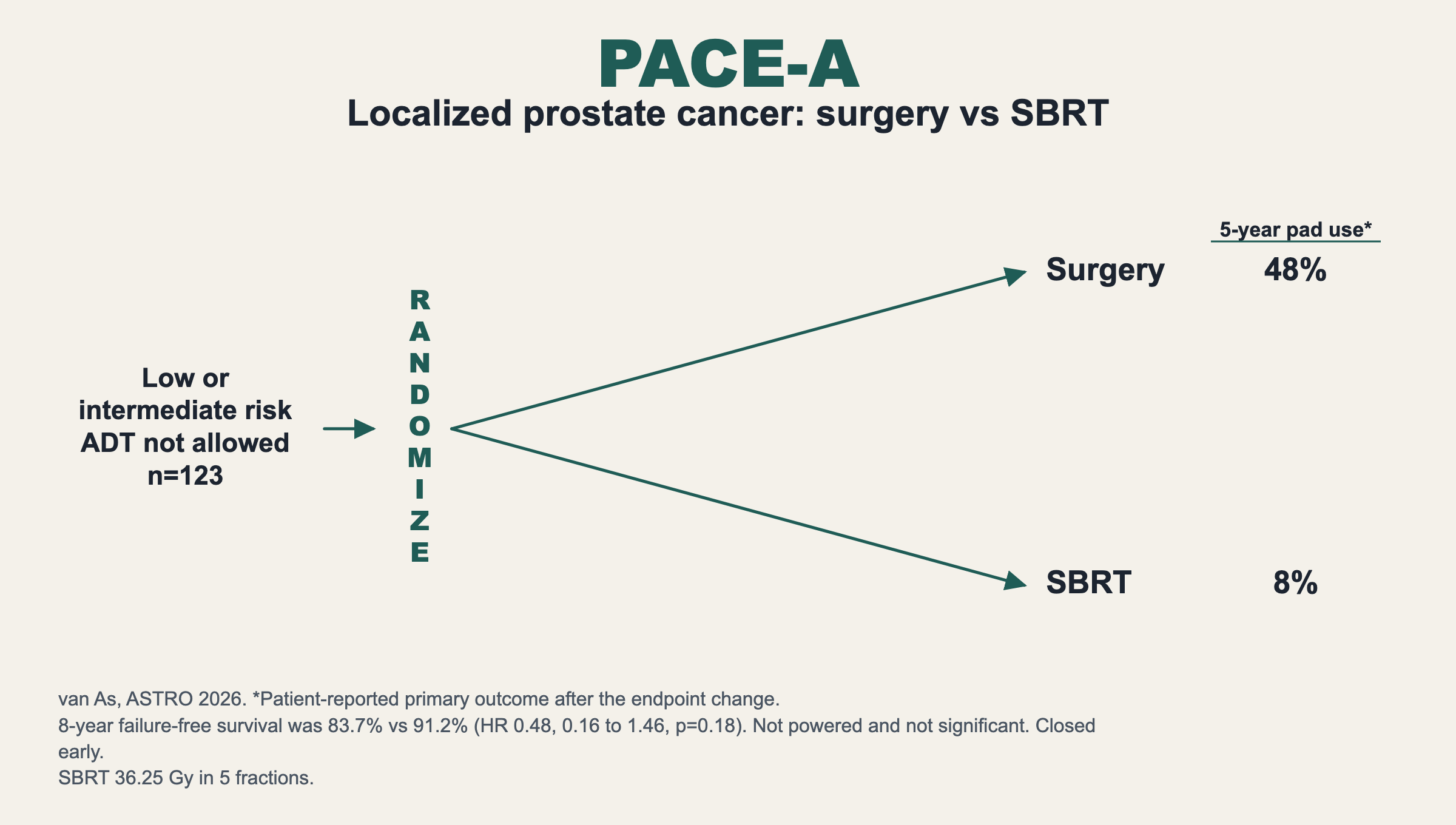
PACE-A. Localized prostate cancer: surgery vs SBRT

Population. Localized low- and intermediate-risk prostate cancer, ADT not allowed

Arms. Radical prostatectomy vs SBRT 36.25 Gy in 5 fractions

Endpoint: Urinary pad use and bowel scores at 2 years

Phase 3, n=123, presented at ASTRO 2026. Five-year pad use was 48% after prostatectomy and 8% after SBRT. Eight-year failure-free survival was 83.7% after prostatectomy and 91.2% after SBRT (HR 0.48, 95% CI 0.16 to 1.46, p=0.18). That endpoint was not powered and was not significant. The trial closed early and changed its primary endpoint.

Takeaway. Not a superiority claim. It is the first phase 3 to show long-term cancer control in the same range as prostatectomy, with a large urinary-function gap favoring SBRT. Prostatectomy is one of the two arms. Directly changes the surgery-versus-SBRT conversation for operable localized prostate cancer.

Paper not linked

RTOG 0534 / SPPORT

NCT00567580

Phase 3Practice-informingMed oncRad onc

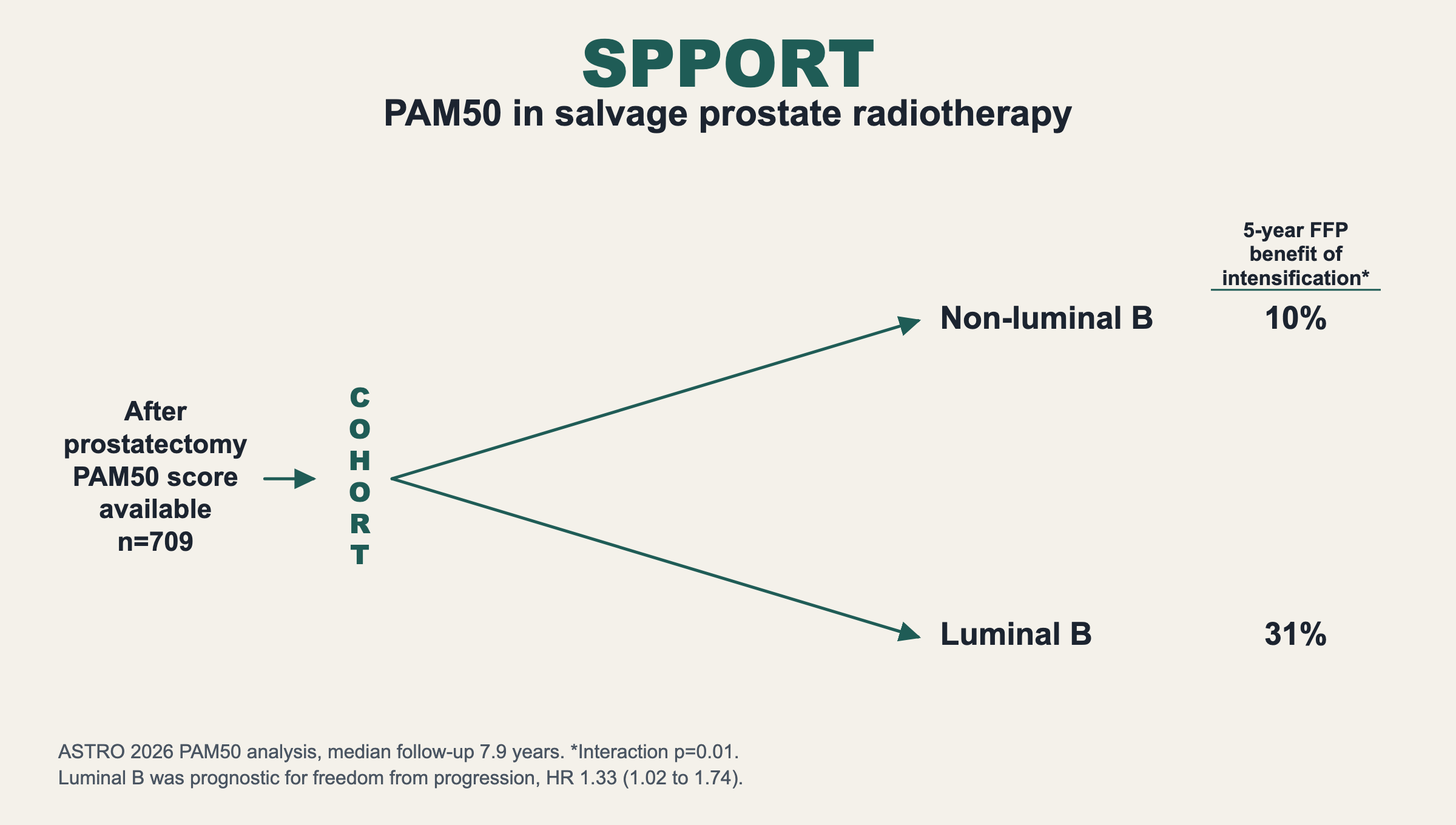
SPPORT. PAM50 in salvage prostate radiotherapy

Population. Salvage radiotherapy after prostatectomy, with a PAM50 score

Arms. Non-luminal B vs Luminal B

Endpoint: Benefit of intensification by luminal B status

ASTRO 2026 PAM50 analysis of SPPORT, 709 patients with scores, median follow-up 7.9 years. The 5-year freedom-from-progression benefit of adding ADT, with or without pelvic nodes, was 10% in non-luminal B tumors and 31% in luminal B tumors (interaction p=0.01). Luminal B was prognostic for freedom from progression (HR 1.33, 95% CI 1.02 to 1.74).

Takeaway. SPPORT supports an established salvage standard. The PAM50 analysis informs treatment selection but does not itself establish a new standard. Short-term ADT is part of the salvage question. Pelvic nodal coverage and short-term ADT in the salvage setting are day-to-day rad onc decisions.

VOLGA

NCT04960709

Phase 3Practice-informingMed oncSurg oncRad onc

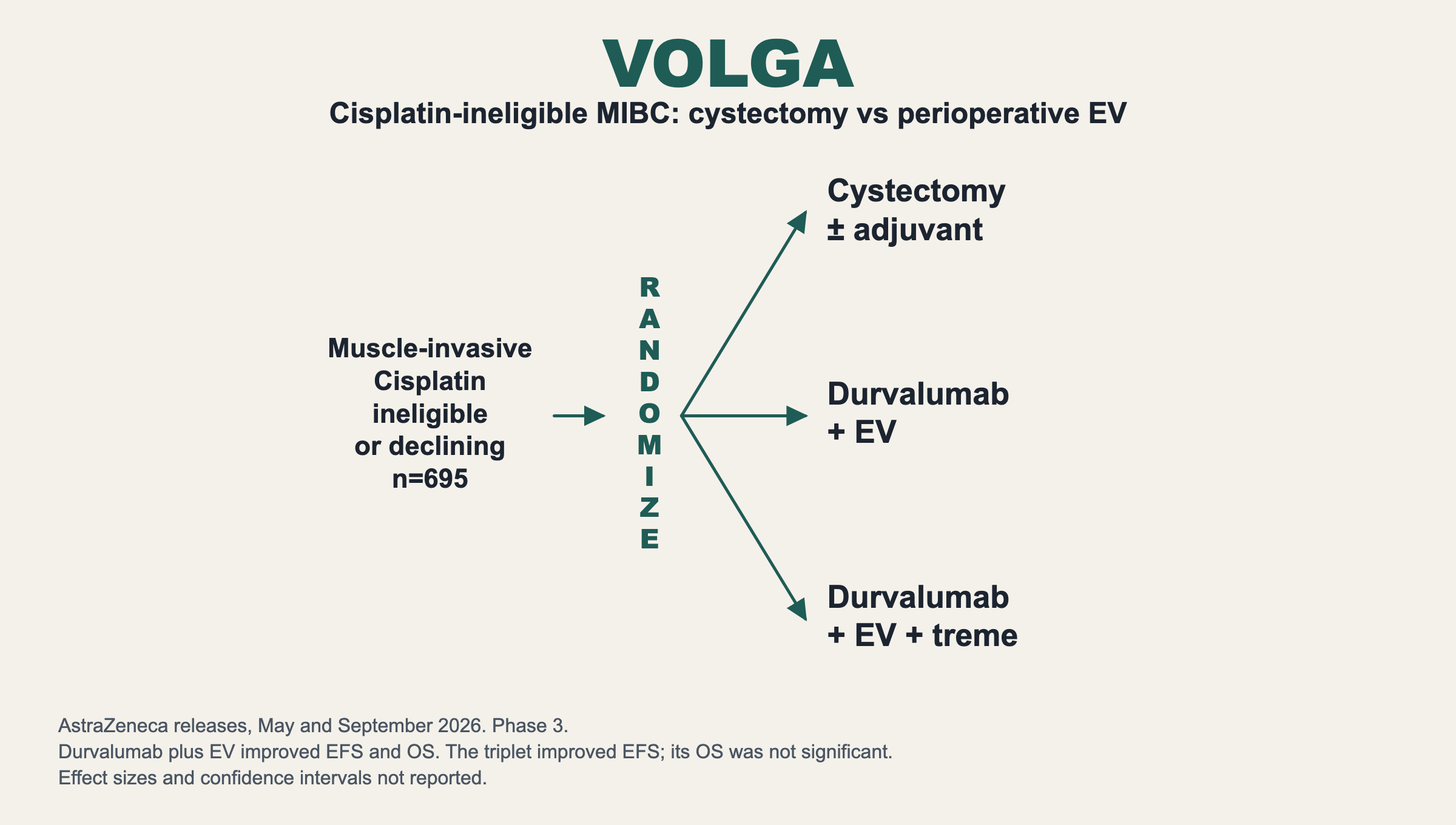
VOLGA. Cisplatin-ineligible MIBC: cystectomy vs perioperative EV

Population. Cisplatin-ineligible or cisplatin-declining muscle-invasive bladder cancer

Arms. Cystectomy with or without adjuvant therapy vs Perioperative durvalumab plus neoadjuvant enfortumab vedotin vs That combination plus tremelimumab

Endpoint: Event-free and overall survival

Phase 3, 695 patients. The May 14, 2026 sponsor announcement reported significant EFS and OS improvements with perioperative durvalumab plus neoadjuvant enfortumab vedotin versus cystectomy with or without adjuvant therapy. Adding tremelimumab also improved EFS, but its OS comparison was not significant. The September 25 announcement concerned FDA priority review. As of September 30, effect sizes and confidence intervals were not reported.

Takeaway. As of September 2026, the positive sponsor topline announcement was promising but insufficient to establish a practice change without public effect sizes and detailed safety results. Perioperative immunotherapy and an antibody-drug conjugate in cisplatin-ineligible disease. Cystectomy is the control, so this changes who is offered surgery. It changes the cisplatin-ineligible pathway, where bladder-preserving chemoradiotherapy is the main alternative to cystectomy.

NRG-GU003

NCT03274687

Phase 3Practice-informingRad onc

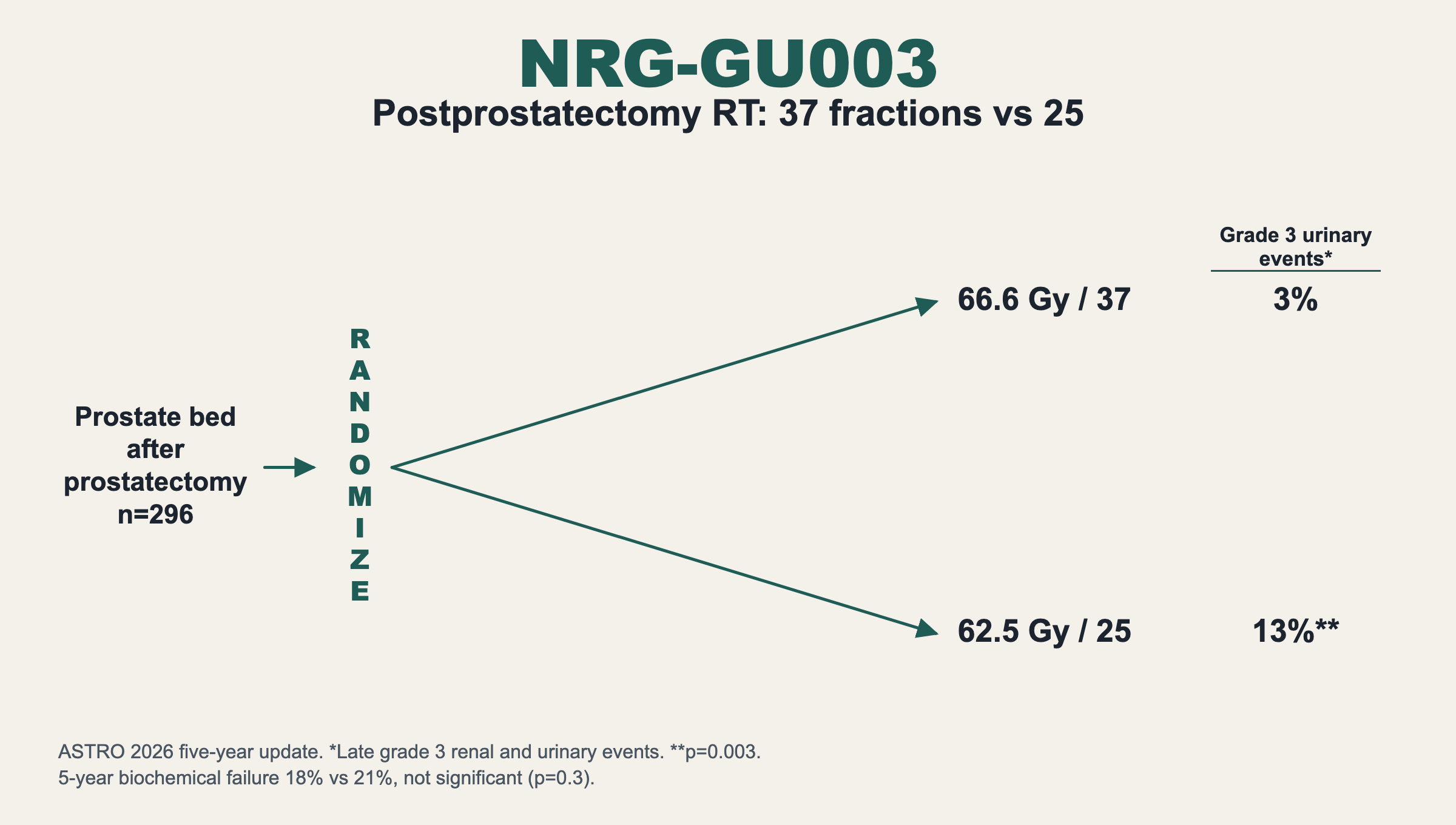
NRG-GU003. Postprostatectomy RT: 37 fractions vs 25

Population. Postprostatectomy radiotherapy

Arms. 66.6 Gy in 37 fractions vs 62.5 Gy in 25 fractions

Endpoint: Patient-reported urinary and bowel symptoms

ASTRO 2026 five-year update, n=296. The report is about late toxicity. Grade 3 renal and urinary events were 3% with 66.6 Gy in 37 fractions and 13% with 62.5 Gy in 25 fractions (p=0.003). Five-year biochemical failure was 18% vs 21% and was not significant (p=0.3). Five-year patient-reported bowel and urinary scores were not significantly different.

Takeaway. The five-year ASTRO update keeps biochemical control similar and raises grade 3 urinary toxicity with hypofractionation. That argues for caution, not a new standard. A fractionation choice for salvage and adjuvant prostate-bed radiotherapy, now with a five-year toxicity update.

LITESPARK-011

NCT04586231

Phase 3Practice-changingMed onc

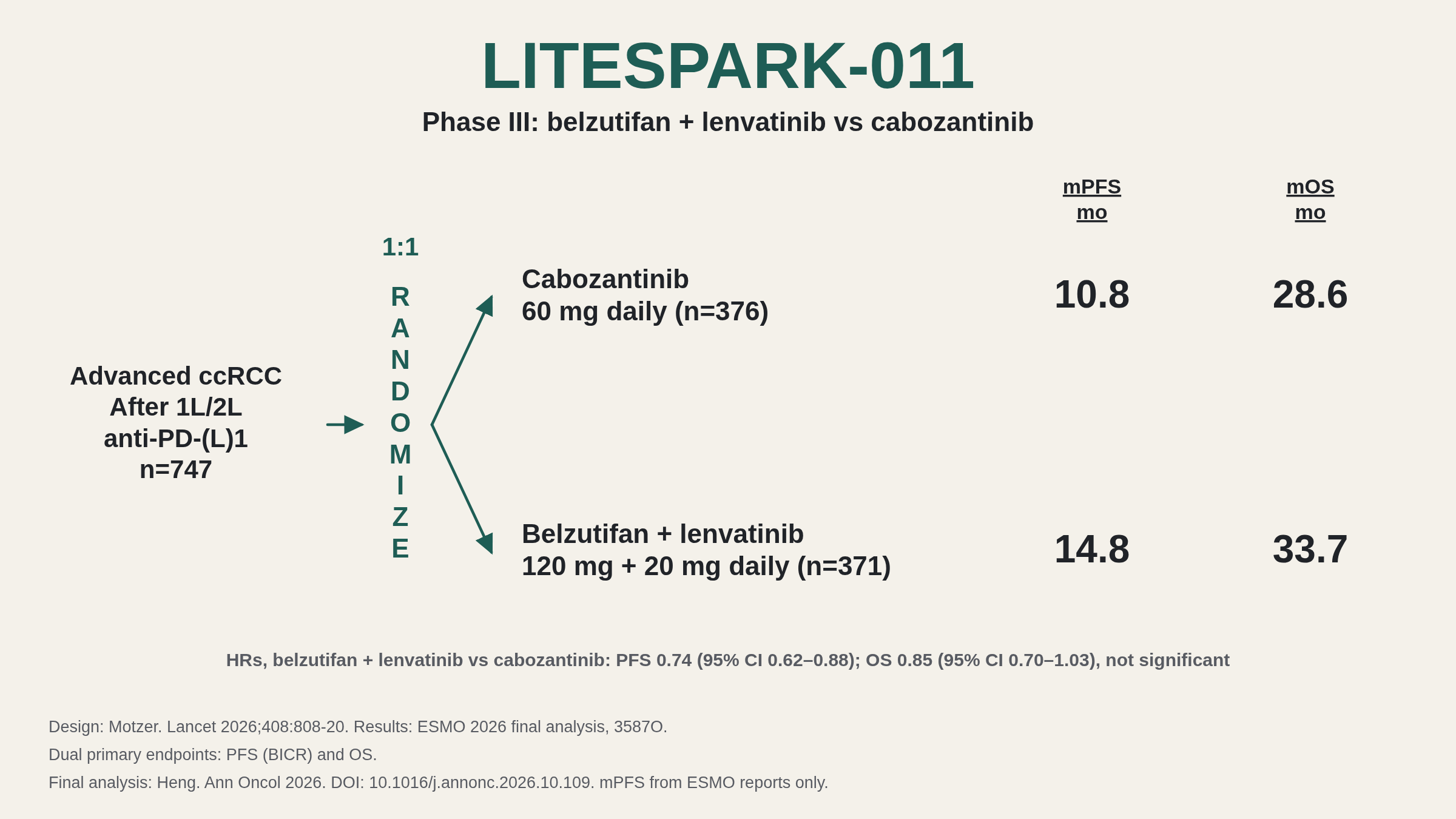
LITESPARK-011. Post-immunotherapy kidney cancer: cabo vs belzu + lenva

Population. Advanced clear-cell kidney cancer after PD-1 or PD-L1 therapy

Arms. Cabozantinib vs Belzutifan plus lenvatinib

Endpoint: Progression-free survival

Phase 3, n=747. At the ESMO 2026 final analysis, median progression-free survival was 10.8 months with cabozantinib and 14.8 months with belzutifan plus lenvatinib (HR 0.74, 95% CI 0.62 to 0.88). This descriptive update showed continued PFS benefit with longer follow-up; PFS was not formally retested. Mature median overall survival was 28.6 vs 33.7 months (HR 0.85, 95% CI 0.70 to 1.03) and was not statistically significant (one-sided p=0.047 vs prespecified boundary 0.0223).

Takeaway. A phase 3 win over an active comparator in the post-immunotherapy setting. A systemic choice after immunotherapy in advanced kidney cancer.

GI

GlutaPanc / IIT2020-02

NCT04634539

Phase 1Practice-informingMed onc

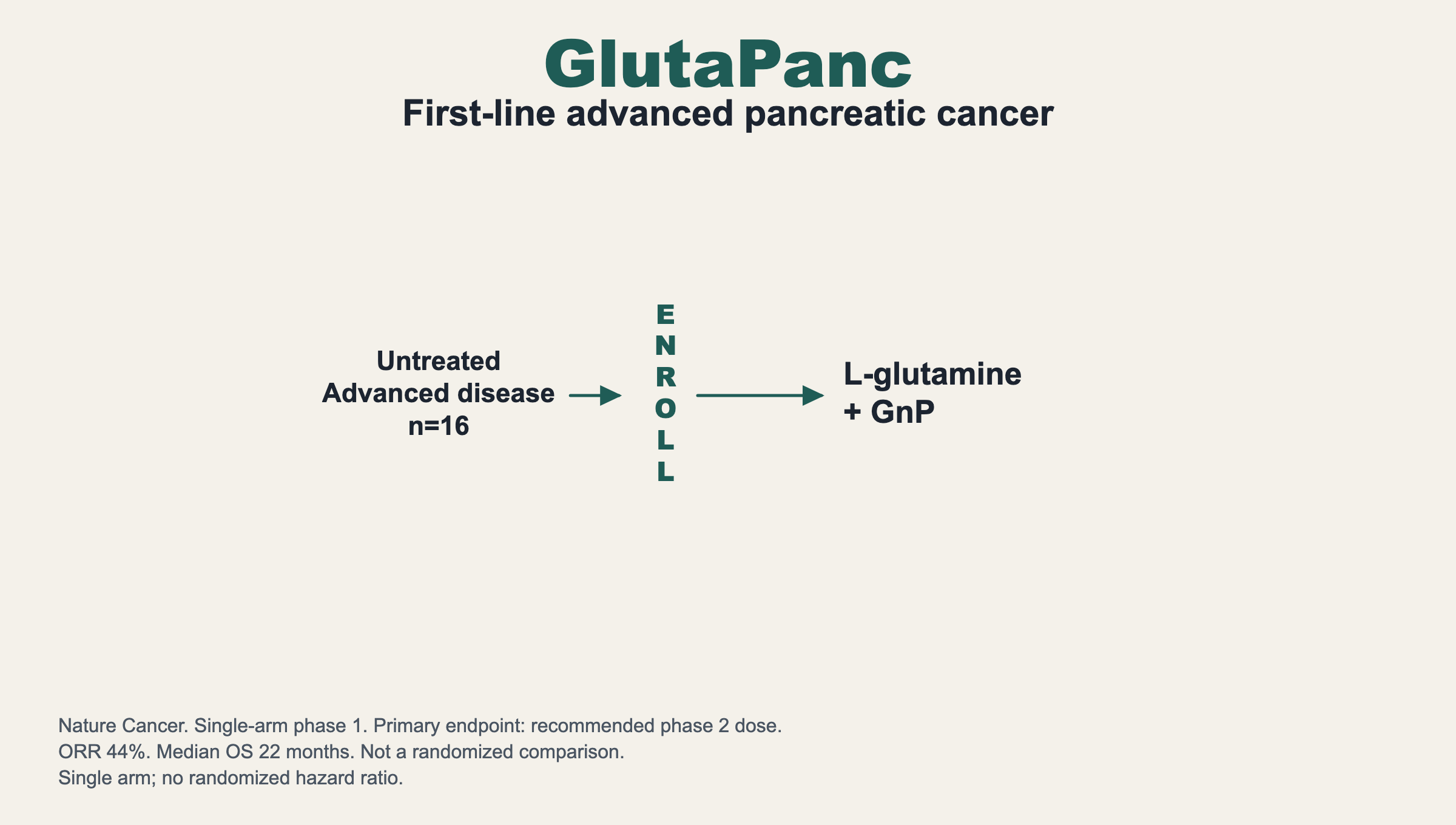
GlutaPanc. First-line advanced pancreatic cancer

Population. Untreated advanced pancreatic cancer

Arms. L-glutamine plus gemcitabine and nab-paclitaxel

Endpoint: Recommended phase 2 dose

Single-arm phase 1, n=16, Nature Cancer. Tumor shrinkage in 94%, objective response 44% including a 12.5% complete response rate, median PFS 8.5 months, median OS 22 months. The authors compare that OS with historical gemcitabine and nab-paclitaxel. Grade 3 or higher treatment-related toxicity was 66.7%, mostly from the chemotherapy.

Takeaway. A small single-arm phase 1 study is hypothesis-generating and cannot establish benefit over chemotherapy alone. A first-line systemic combination, still a dose-finding study.

KRYSTAL-10

NCT04793958

Phase 3Practice-informingMed onc

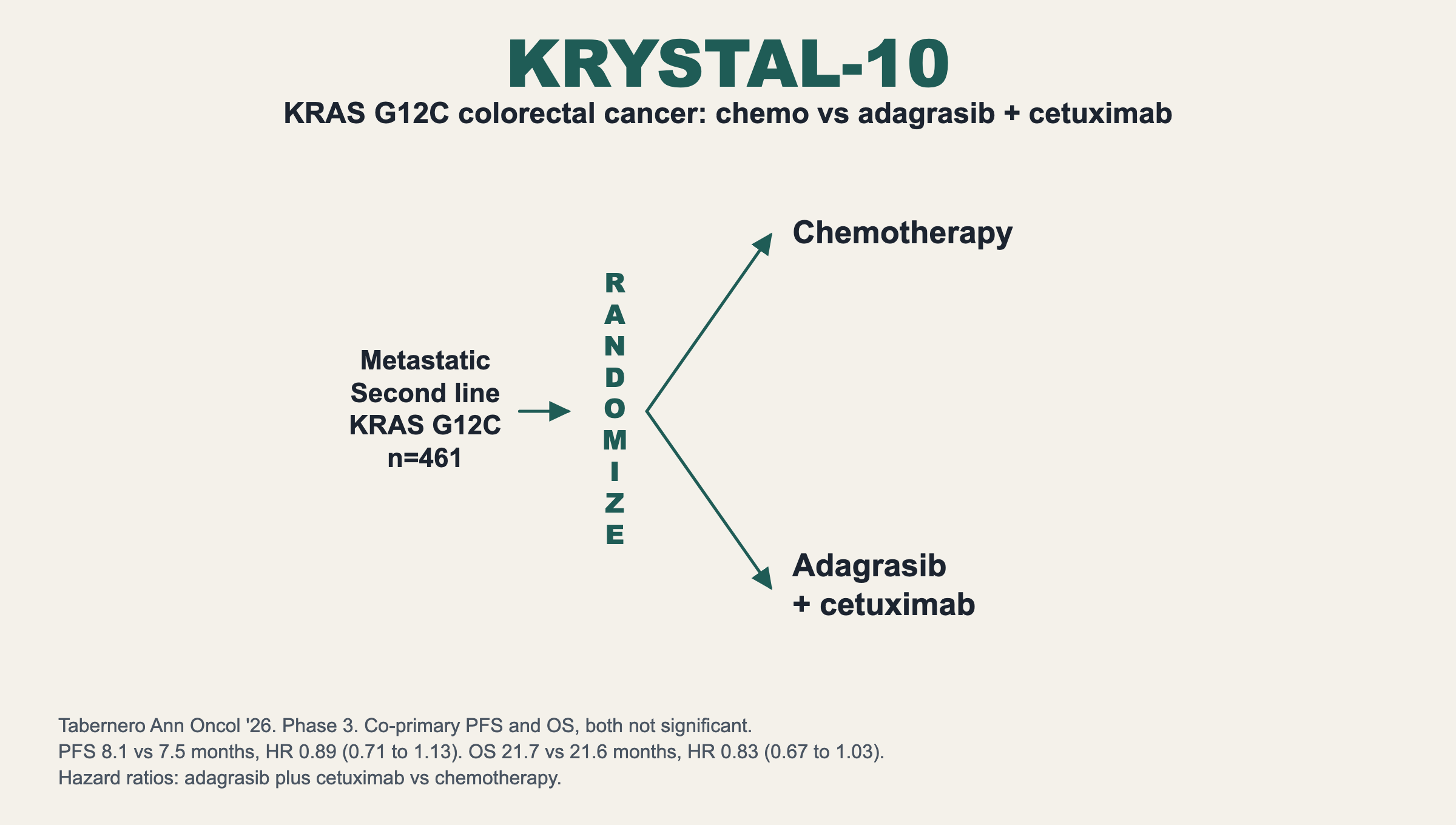
KRYSTAL-10. KRAS G12C colorectal cancer: chemo vs adagrasib + cetuximab

Population. Second-line KRAS G12C metastatic colorectal cancer

Arms. Chemotherapy vs Adagrasib plus cetuximab

Endpoint: Progression-free and overall survival

Phase 3 final analysis, n=461. Median PFS was 8.1 months with chemotherapy and 7.5 months with adagrasib plus cetuximab (HR 0.89, 95% CI 0.71 to 1.13, p=0.32), not significant. Median OS was 21.7 vs 21.6 months (HR 0.83, 95% CI 0.67 to 1.03, p=0.09), not significant. ORR was 16% vs 47%. Hazard ratios compare adagrasib plus cetuximab with chemotherapy.

Takeaway. The trial did not improve either primary endpoint, PFS or OS, despite a higher response rate. A systemic targeted-versus-chemotherapy question in KRAS G12C colorectal cancer.

LAVA-CRLM

NCT03654131

Phase 2Practice-informingSurg oncRad onc

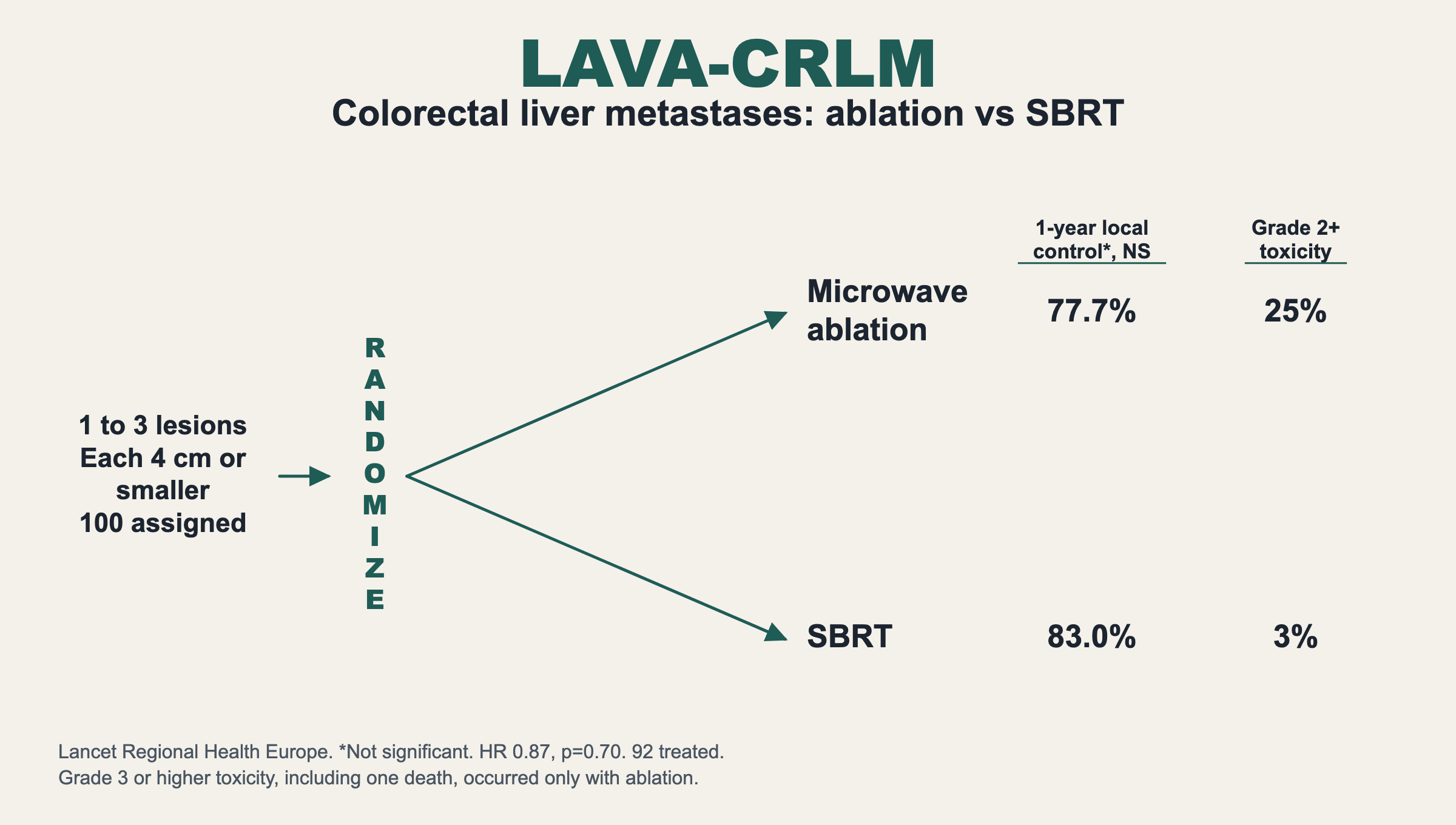
LAVA-CRLM. Colorectal liver metastases: ablation vs SBRT

Population. One to three colorectal liver metastases, each 4 cm or smaller

Arms. Microwave ablation vs SBRT

Endpoint: Freedom from local progression

Randomized phase 2, 100 assigned, 92 treated. One-year freedom from local progression was 77.7% with microwave ablation and 83.0% with SBRT (HR 0.87, p=0.70), not significant. Grade 2 or higher treatment-related toxicity was 25% vs 3%. Grade 3 or higher toxicity, including one treatment-related death, occurred only with ablation.

Takeaway. Local control was similar, so this informs the choice of SBRT versus ablation rather than replacing one with the other. Ablation versus SBRT is a local-therapy choice surgical oncology shares. A direct SBRT-versus-ablation trial for oligometastatic colorectal liver metastases.

RASolute 302

NCT06625320

Phase 3Practice-changingMed onc

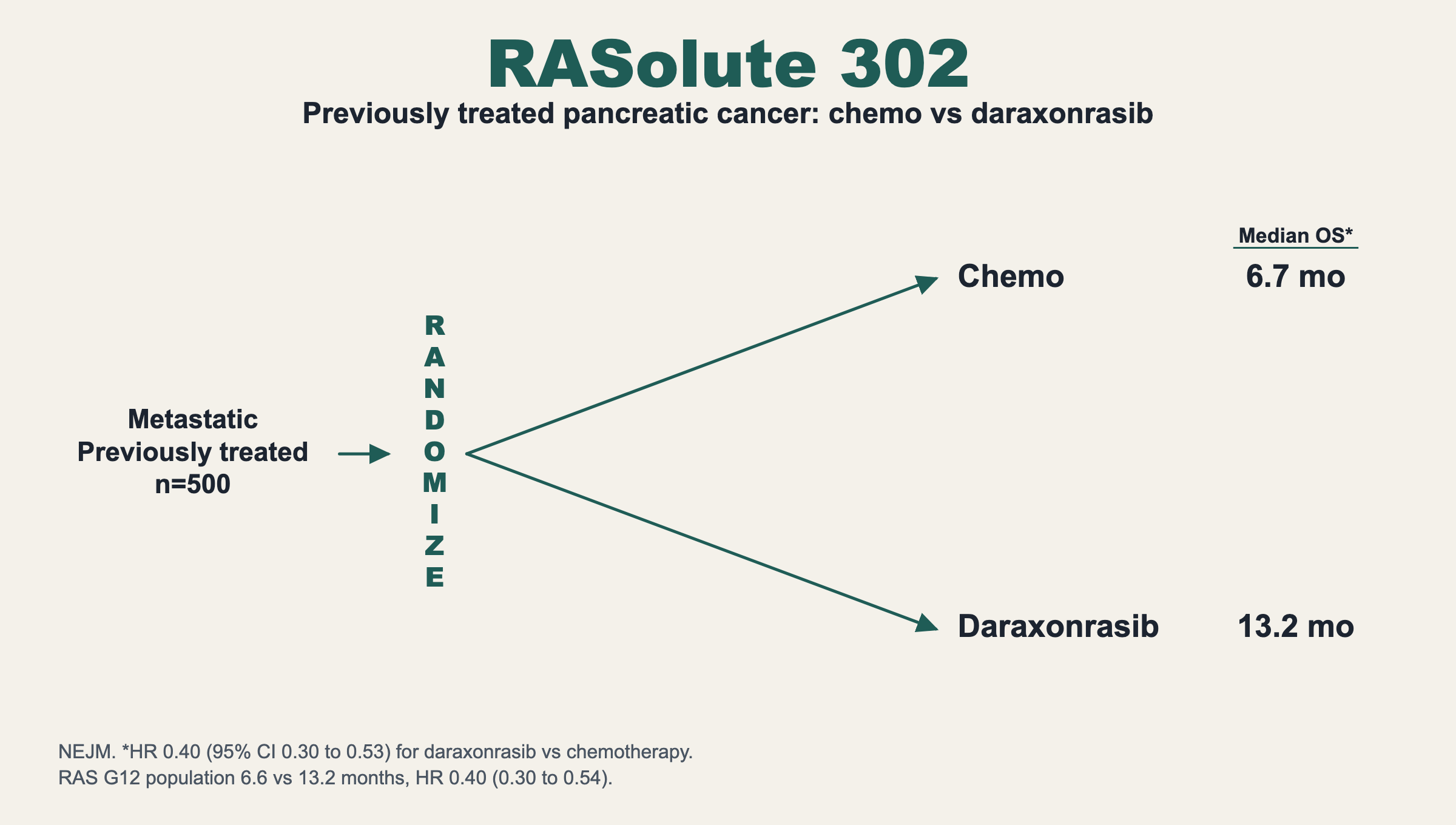
RASolute 302. Previously treated pancreatic cancer: chemo vs daraxonrasib

Population. Previously treated metastatic pancreatic cancer

Arms. Investigator's choice of chemotherapy vs Daraxonrasib

Endpoint: Overall survival

Phase 3, n=500. Overall survival was 6.7 months with chemotherapy and 13.2 months with daraxonrasib (HR 0.40, 95% CI 0.30 to 0.53). In the RAS G12 population it was 6.6 vs 13.2 months (HR 0.40, 95% CI 0.30 to 0.54).

Takeaway. The randomized phase 3 OS benefit over chemotherapy supports a new treatment option for previously treated metastatic pancreatic cancer. A systemic option after prior treatment for metastatic pancreatic cancer.

EMERALD-3

NCT05301842

Phase 3Practice-changingMed oncRad onc

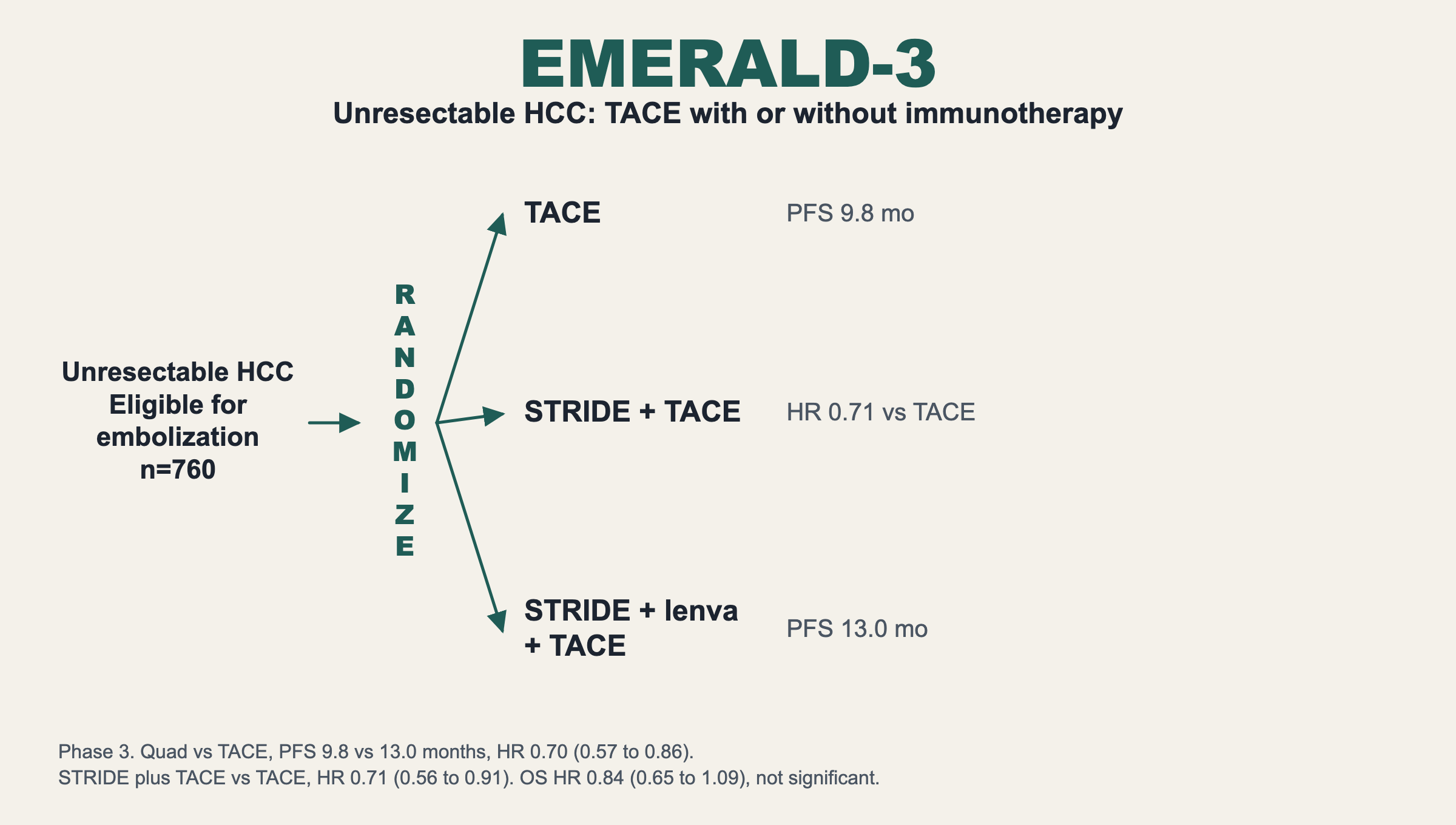
EMERALD-3. Unresectable HCC: TACE with or without immunotherapy

Population. Unresectable hepatocellular carcinoma eligible for embolization

Arms. TACE vs STRIDE plus TACE vs STRIDE plus lenvatinib plus TACE

Endpoint: Progression-free survival

Phase 3, 760 patients, three arms. Progression-free survival was 9.8 months with TACE and 13.0 months with STRIDE plus lenvatinib plus TACE (HR 0.70, 95% CI 0.57 to 0.86, p=0.0007). STRIDE plus TACE versus TACE was HR 0.71 (95% CI 0.56 to 0.91). Overall survival was 34.7 vs 39.5 months (HR 0.84, 95% CI 0.65 to 1.09, p=0.18), not significant.

Takeaway. Positive phase 3 PFS for TACE plus immunotherapy. Overall survival is not mature enough for a clean standard-of-care claim. Immunotherapy added to locoregional therapy for unresectable HCC. Locoregional therapy plus systemic therapy in HCC, where SBRT is often the alternative local option.

Paper not linked

MATTERHORN

NCT04592913

Phase 3Practice-changingMed oncSurg onc

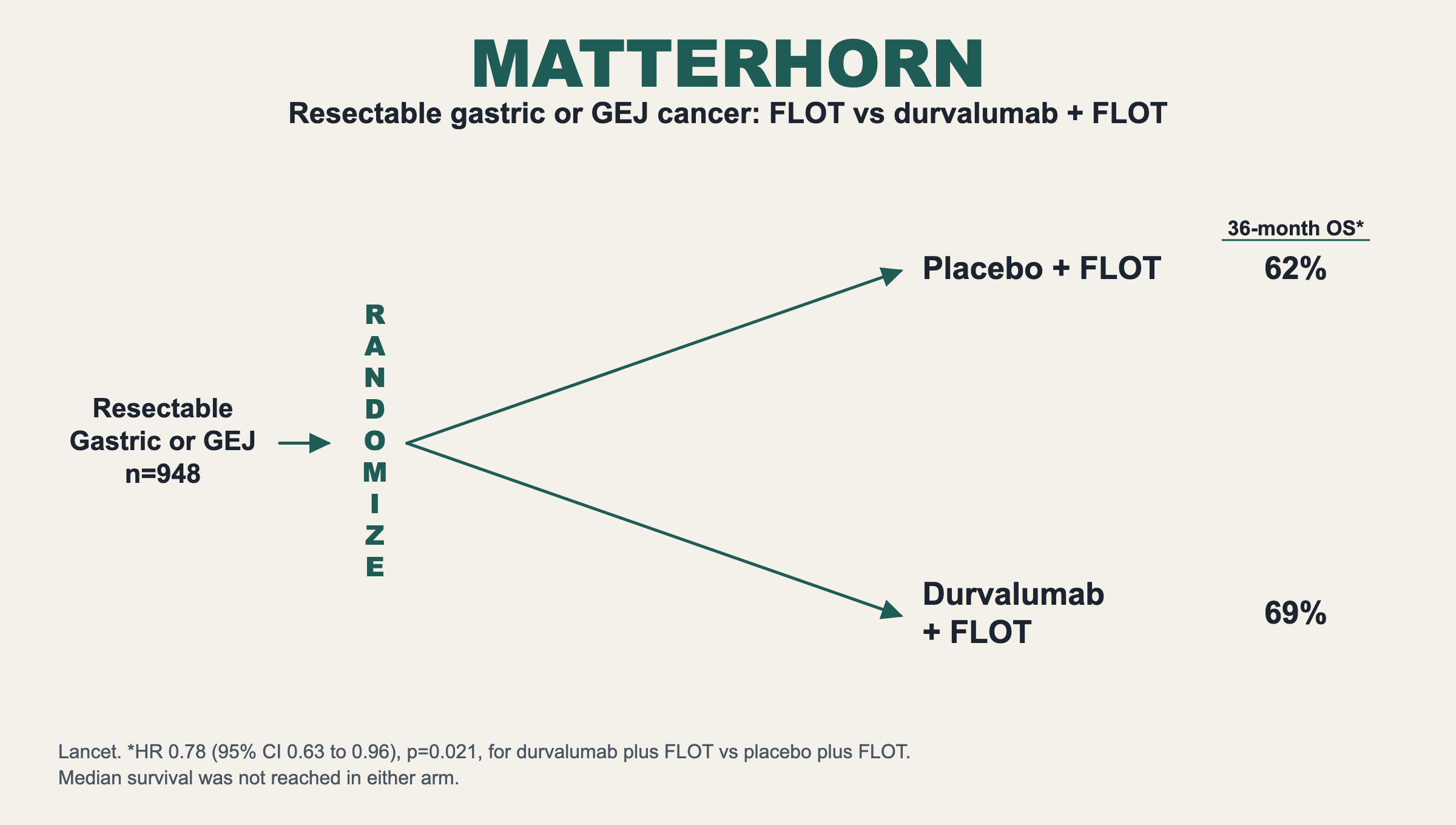
MATTERHORN. Resectable gastric or GEJ cancer: FLOT vs durvalumab + FLOT

Population. Resectable gastric or gastroesophageal junction adenocarcinoma

Arms. Placebo plus FLOT vs Perioperative durvalumab plus FLOT

Endpoint: Overall survival

Phase 3, n=948. At 36 months, overall survival was 62% with placebo plus FLOT and 69% with durvalumab plus FLOT (HR 0.78, 95% CI 0.63 to 0.96, p=0.021). Median survival was not reached in either arm.

Takeaway. A phase 3 overall survival benefit for adding durvalumab to perioperative FLOT. Perioperative immunotherapy added to FLOT. This is a resectable gastric cancer question, decided before the operation.

Breast

SERENA-4

NCT04711252

Phase 3Practice-informingMed onc

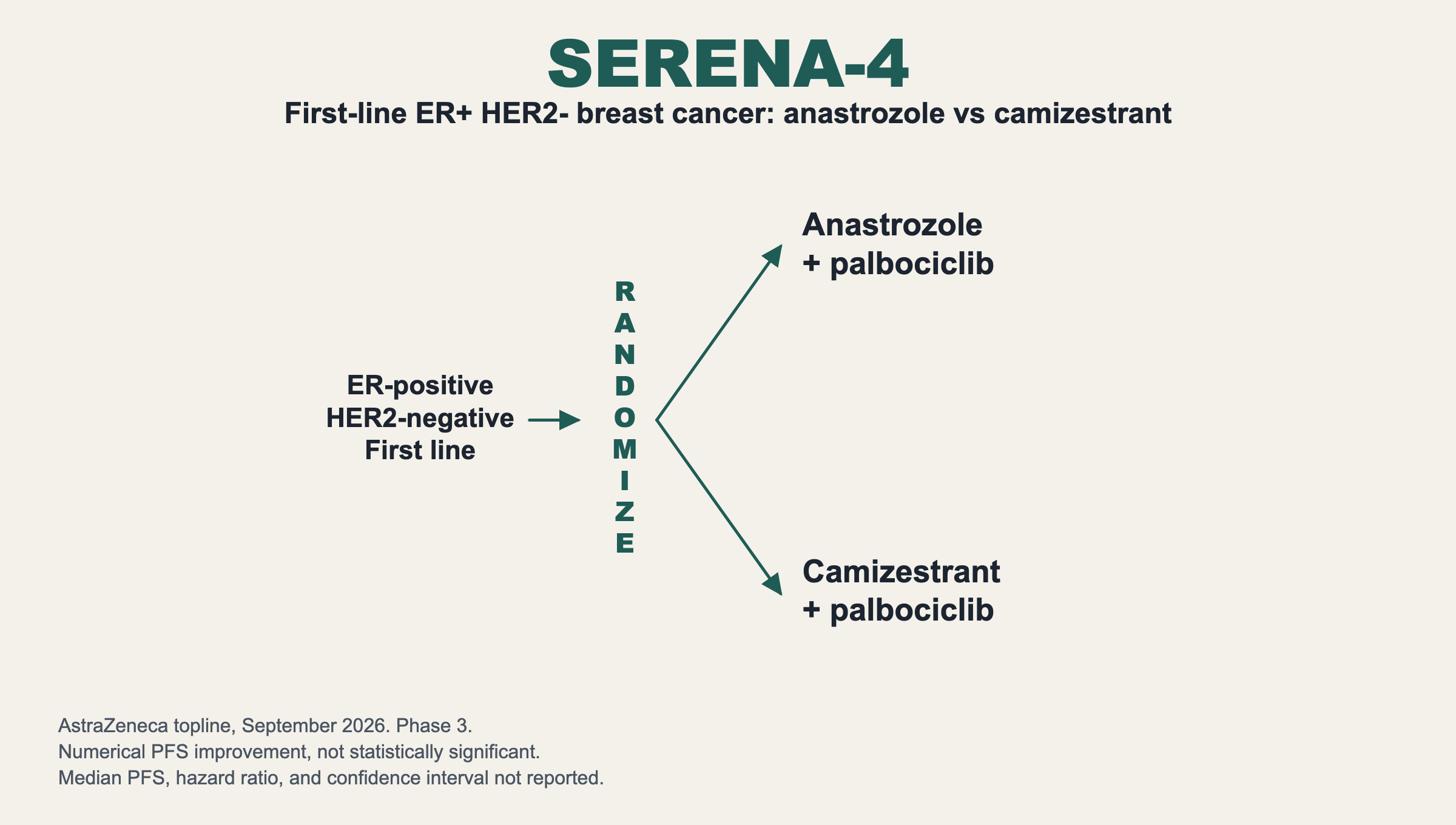
SERENA-4. First-line ER+ HER2- breast cancer: anastrozole vs camizestrant

Population. First-line ER-positive, HER2-negative advanced breast cancer

Arms. Anastrozole plus palbociclib vs Camizestrant plus palbociclib

Phase 3 comparison of anastrozole plus palbociclib with camizestrant plus palbociclib. The September 11, 2026 sponsor announcement reported a numerical PFS improvement that did not meet the primary endpoint for statistical significance. Median PFS, HR, 95% CI, and numerical OS results were not reported.

Takeaway. The primary PFS endpoint was not met, so these results do not support replacing upfront anastrozole plus palbociclib with camizestrant plus palbociclib. A first-line endocrine and CDK4/6 question.

SERENA-6

NCT04964934

Phase 3Practice-changingMed onc

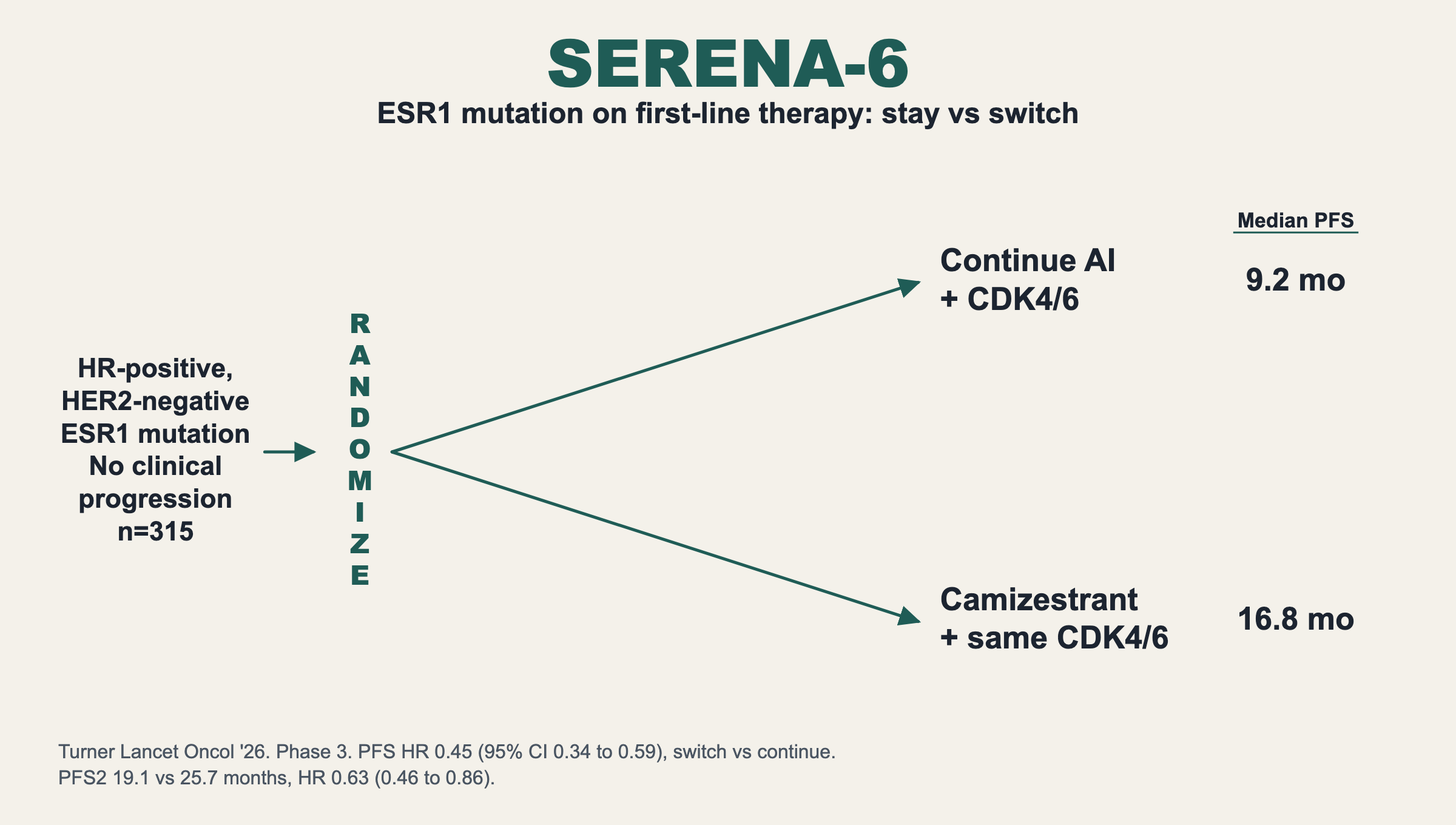
SERENA-6. ESR1 mutation on first-line therapy: stay vs switch

Population. HR-positive, HER2-negative metastatic breast cancer on first-line aromatase inhibitor plus a CDK4/6 inhibitor, with an ESR1 mutation and no clinical progression

Arms. Continue the aromatase inhibitor plus the same CDK4/6 inhibitor vs Switch to camizestrant plus the same CDK4/6 inhibitor

Phase 3, n=315. At the January 2, 2026 cutoff and 23.5 months median follow-up, continuing the aromatase inhibitor versus switching to camizestrant, with the same CDK4/6 inhibitor, yielded median PFS of 9.2 vs 16.8 months (HR 0.45, 95% CI 0.34 to 0.59; nominal p<0.0001). Median PFS2 was 19.1 vs 25.7 months (HR 0.63, 95% CI 0.46 to 0.86; p=0.0037). Hazard ratios compare switching with continuing the aromatase inhibitor.

Takeaway. Randomized PFS and PFS2 benefits support an ESR1-guided switch to camizestrant while continuing the same CDK4/6 inhibitor before clinical progression. A ctDNA-guided endocrine switch during first-line therapy.

PATINA

NCT02947685

Phase 3Practice-changingMed onc

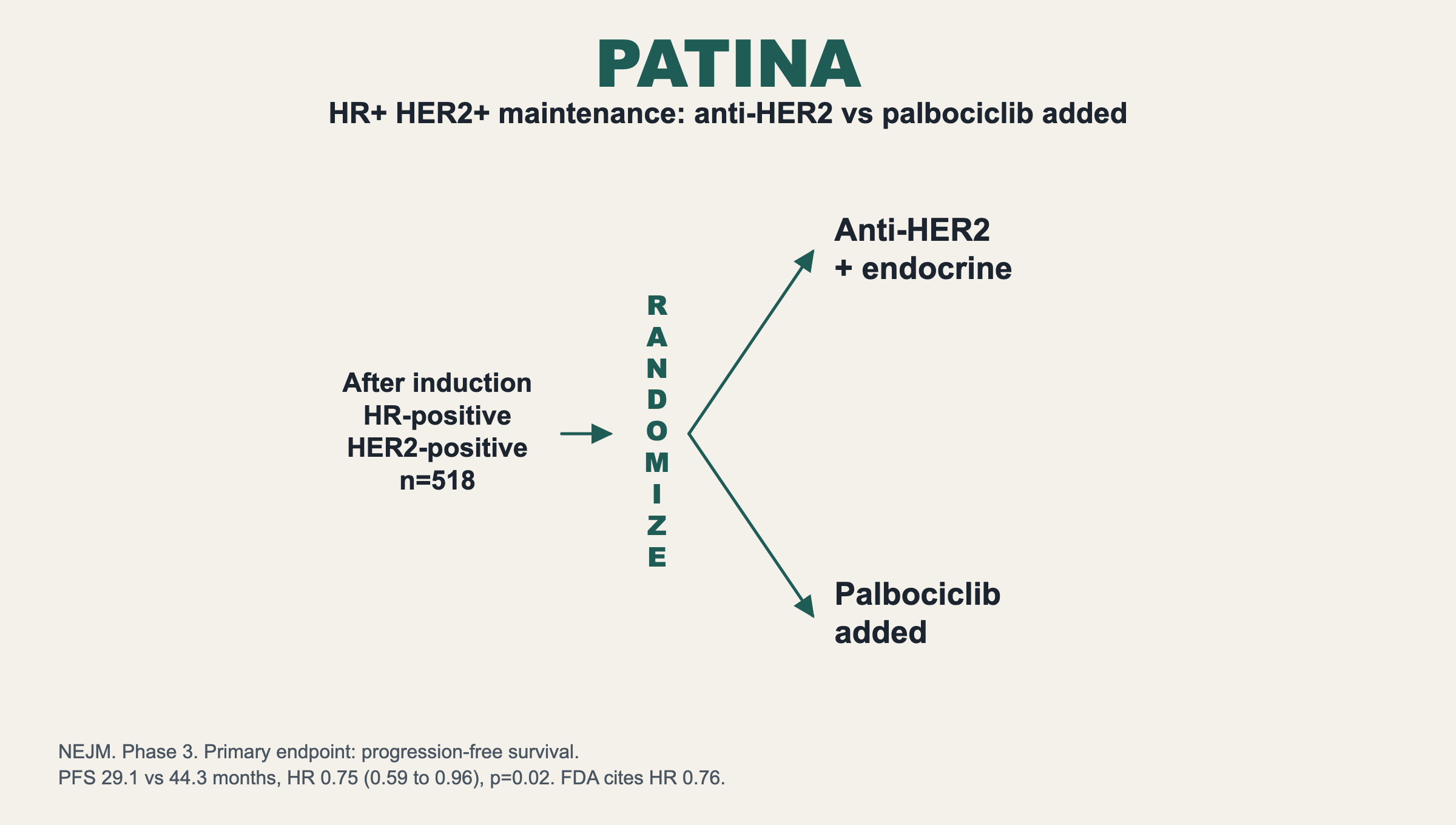
PATINA. HR+ HER2+ maintenance: anti-HER2 vs palbociclib added

Population. HR-positive, HER2-positive metastatic breast cancer after induction

Arms. Anti-HER2 and endocrine maintenance vs Palbociclib added to anti-HER2 and endocrine maintenance

Endpoint: Progression-free survival

Phase 3, n=518. Progression-free survival was 29.1 months with anti-HER2 and endocrine maintenance and 44.3 months with palbociclib added (HR 0.75, 95% CI 0.59 to 0.96, p=0.02). The June 24, 2026 FDA approval cites HR 0.76 and says the median could not be adequately described because of censoring.

Takeaway. A phase 3 maintenance question in HR-positive, HER2-positive disease. Maintenance systemic therapy after induction in HR-positive, HER2-positive disease.

DESTINY-Breast09

NCT04784715

Phase 3Practice-changingMed onc

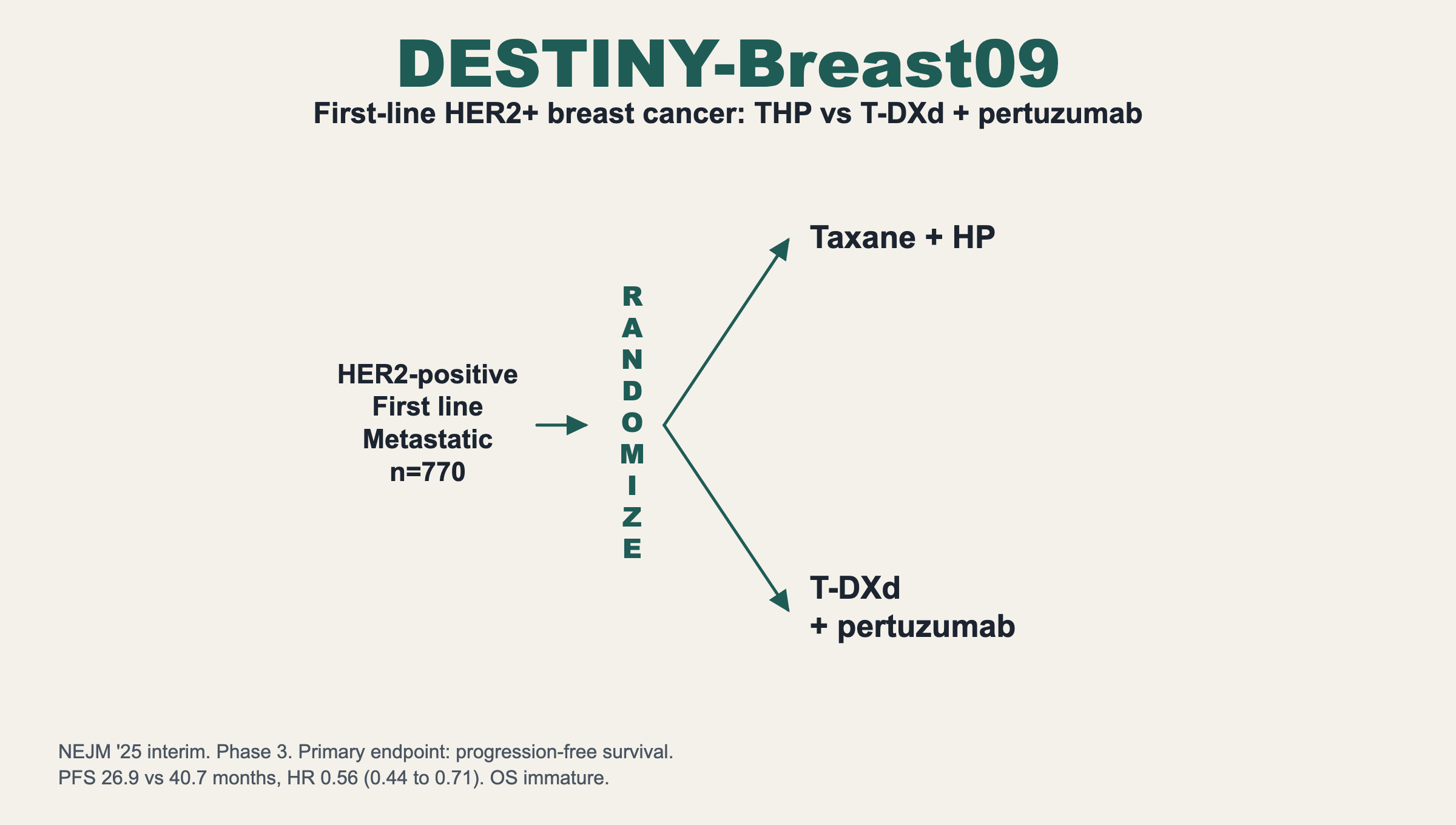
DESTINY-Breast09. First-line HER2+ breast cancer: THP vs T-DXd + pertuzumab

Population. First-line HER2-positive metastatic breast cancer

Arms. Taxane, trastuzumab, and pertuzumab vs Trastuzumab deruxtecan plus pertuzumab

Endpoint: Progression-free survival

Phase 3 prespecified interim comparison, n=770. Median PFS was 26.9 months with taxane, trastuzumab, and pertuzumab and 40.7 months with trastuzumab deruxtecan plus pertuzumab (HR 0.56, 95% CI 0.44 to 0.71). The hazard ratio compares trastuzumab deruxtecan plus pertuzumab with control. OS was immature.

Takeaway. A substantial randomized PFS benefit supports a new first-line option in HER2-positive metastatic breast cancer, while OS follow-up remains immature. A first-line antibody-drug conjugate question in HER2-positive metastatic breast cancer.

AVATAR II

NCT06882499

Phase 2Practice-informingMed oncRad onc

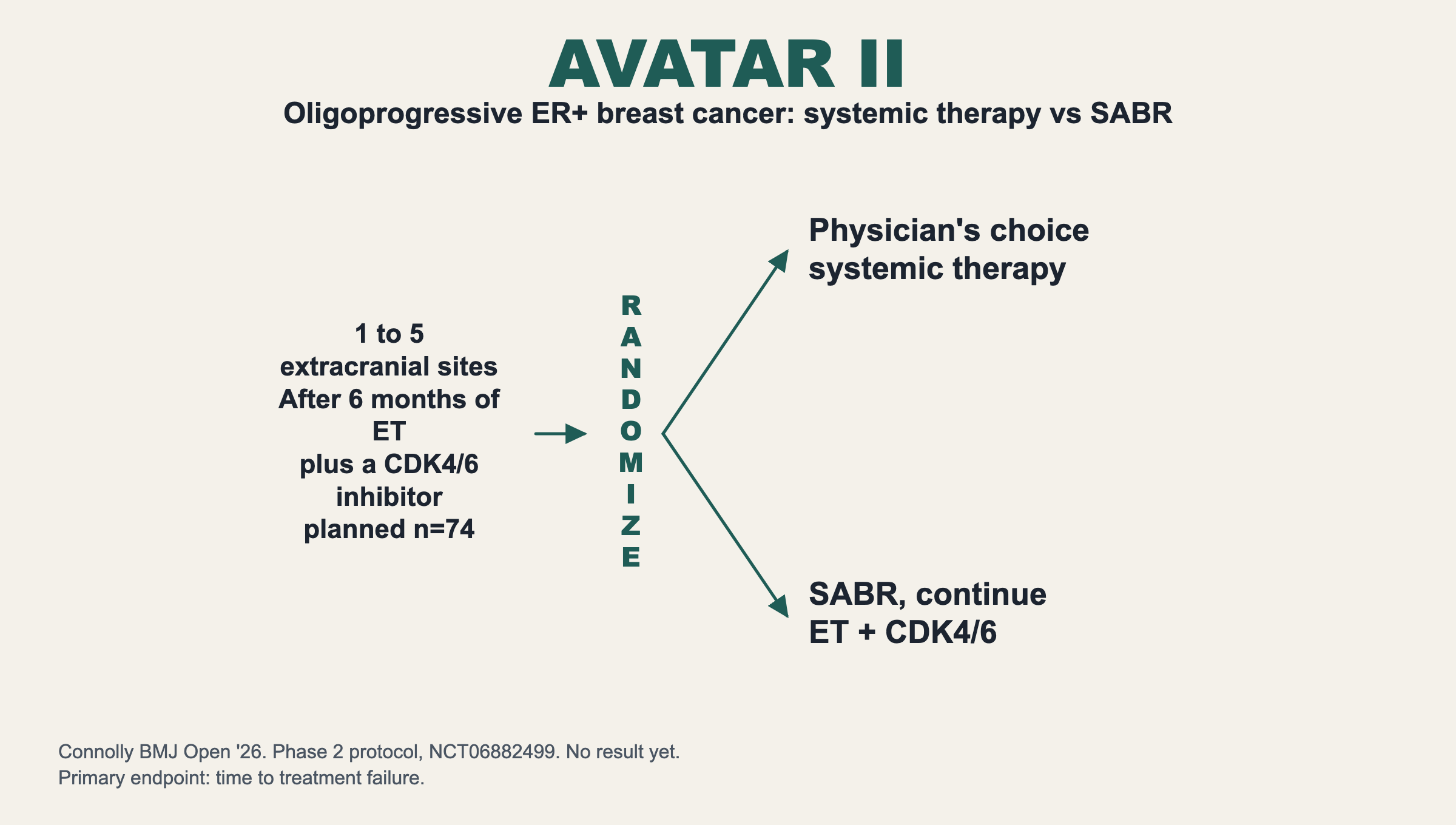
AVATAR II. Oligoprogressive ER+ breast cancer: systemic therapy vs SABR

Population. ER-positive, HER2-negative advanced breast cancer with 1 to 5 oligoprogressive sites after at least 6 months of endocrine therapy plus a CDK4/6 inhibitor

Arms. Physician's choice of systemic therapy vs SABR to oligoprogressive sites, continuing endocrine therapy and a CDK4/6 inhibitor

Endpoint: Time to treatment failure

Phase 2 randomized protocol, planned n=74, NCT06882499. Patients with ER-positive, HER2-negative advanced breast cancer and 1 to 5 extracranial oligoprogressive sites, after at least 6 months of benefit from endocrine therapy plus a CDK4/6 inhibitor, are randomized to SABR to all progressing sites while continuing that therapy, or to physician's choice of systemic therapy. Primary endpoint: time to treatment failure. Accrual was planned to open in August 2026. No efficacy result has been reported.

Takeaway. This is a protocol. There is no result yet. Endocrine therapy and a CDK4/6 inhibitor are part of the maintenance design. SABR in metastatic breast cancer is a rad onc question, and it is worth tracking before there are numbers.

Lung

MAVERICK / SWOG S1827

NCT04155034

Phase 3Practice-changingRad onc

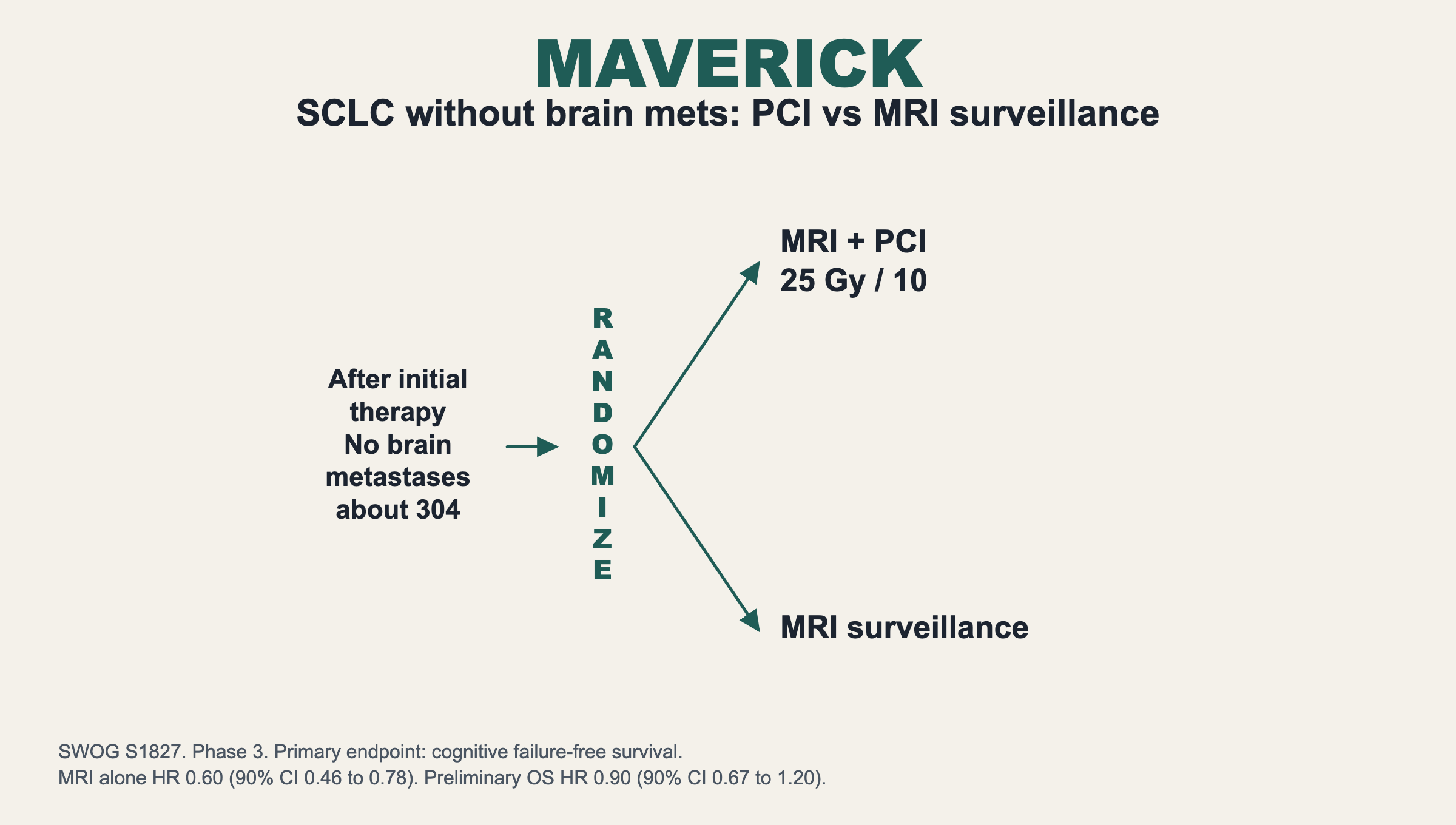
MAVERICK. SCLC without brain mets: PCI vs MRI surveillance

Population. Small-cell lung cancer without brain metastases after initial therapy

Arms. MRI surveillance plus PCI 25 Gy in 10 fractions vs MRI surveillance alone

Endpoint: Cognitive failure-free survival

Phase 3, about 304 patients analyzed. MRI surveillance alone improved cognitive failure-free survival versus MRI surveillance plus PCI (HR 0.60, 90% CI 0.46 to 0.78). Preliminary OS HR was 0.90 (90% CI 0.67 to 1.20); the confidence interval does not establish absence of a survival cost.

Takeaway. A phase 3 de-escalation result that challenges routine PCI. The survival interval is still too wide to call no survival cost established. This is the PCI decision.

Paper not linked

RMC-6236-001

NCT05379985

Phase 1Practice-informingMed onc

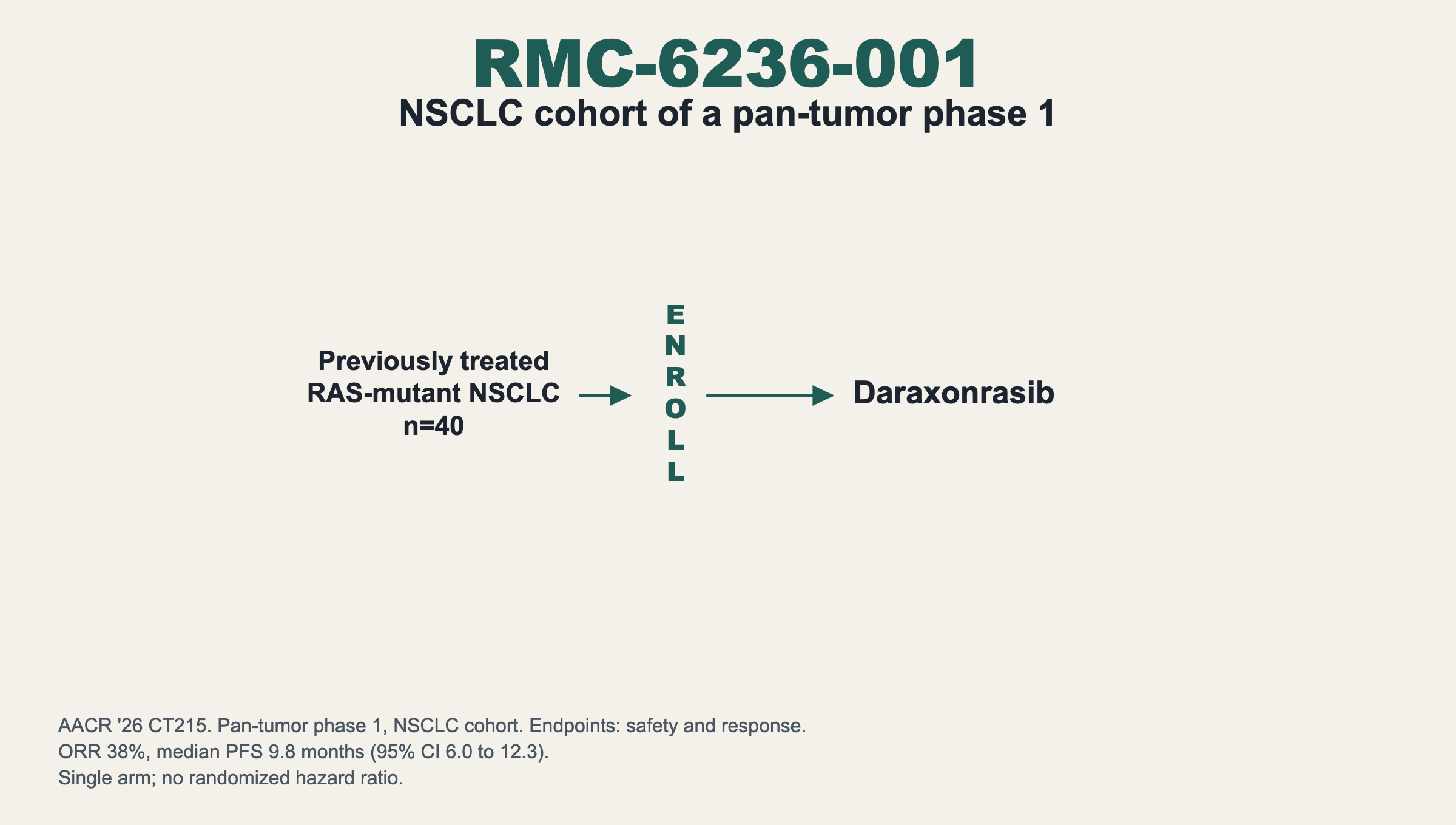
RMC-6236-001. NSCLC cohort of a pan-tumor phase 1

Population. Previously treated RAS-mutant non-small-cell lung cancer

Arms. Daraxonrasib monotherapy

Endpoint: Safety and response

In the NSCLC cohort of this pan-tumor phase 1 study, 40 patients with RAS G12X-mutant disease and one or two prior lines received daraxonrasib 120 to 220 mg daily. At the September 30, 2024 cutoff, confirmed ORR was 38%, median PFS 9.8 months (95% CI 6.0 to 12.3), and median OS 17.7 months (95% CI 13.7 to not estimable). There was no randomized comparator. A later NEJM report evaluated 136 NSCLC patients across doses up to 300 mg at a July 21, 2025 cutoff; that broader population is distinct from the 40-patient cohort.

Takeaway. Nonrandomized early-phase NSCLC activity requires confirmation in a randomized comparison before establishing a new standard. An early systemic RAS inhibitor signal, not a phase 3 result.

DESTINY-Lung04

NCT05048797

Phase 3Practice-changingMed oncRad onc

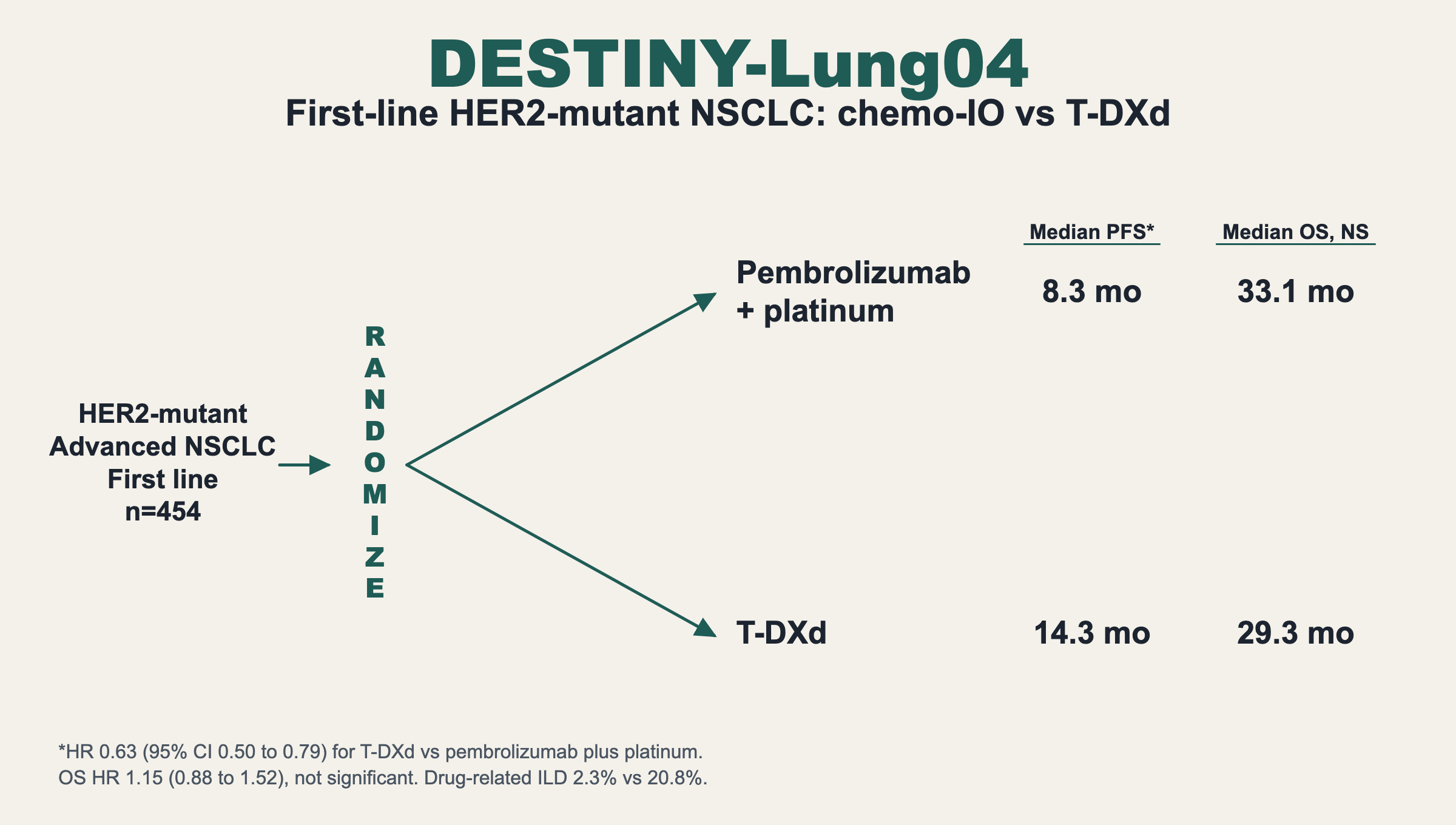
DESTINY-Lung04. First-line HER2-mutant NSCLC: chemo-IO vs T-DXd

Population. First-line HER2-mutant advanced non-small-cell lung cancer

Arms. Pembrolizumab plus platinum chemotherapy vs Trastuzumab deruxtecan

Endpoint: Progression-free survival

Phase 3, n=454. Progression-free survival was 8.3 months with pembrolizumab plus platinum and 14.3 months with trastuzumab deruxtecan (HR 0.63, 95% CI 0.50 to 0.79). Overall survival was 33.1 vs 29.3 months (HR 1.15, 95% CI 0.88 to 1.52), not significant. Drug-related interstitial lung disease was 2.3% vs 20.8%.

Takeaway. First positive phase 3 on PFS in first-line HER2-mutant NSCLC, with an overall survival hazard ratio above 1 and a one-in-five ILD rate. A first-line systemic choice in HER2-mutant lung cancer. A 20.8% drug-related ILD rate changes the risk of thoracic radiotherapy around T-DXd.

Paper not linked

DeLLphi-305

NCT06211036

Phase 3Practice-informingMed onc

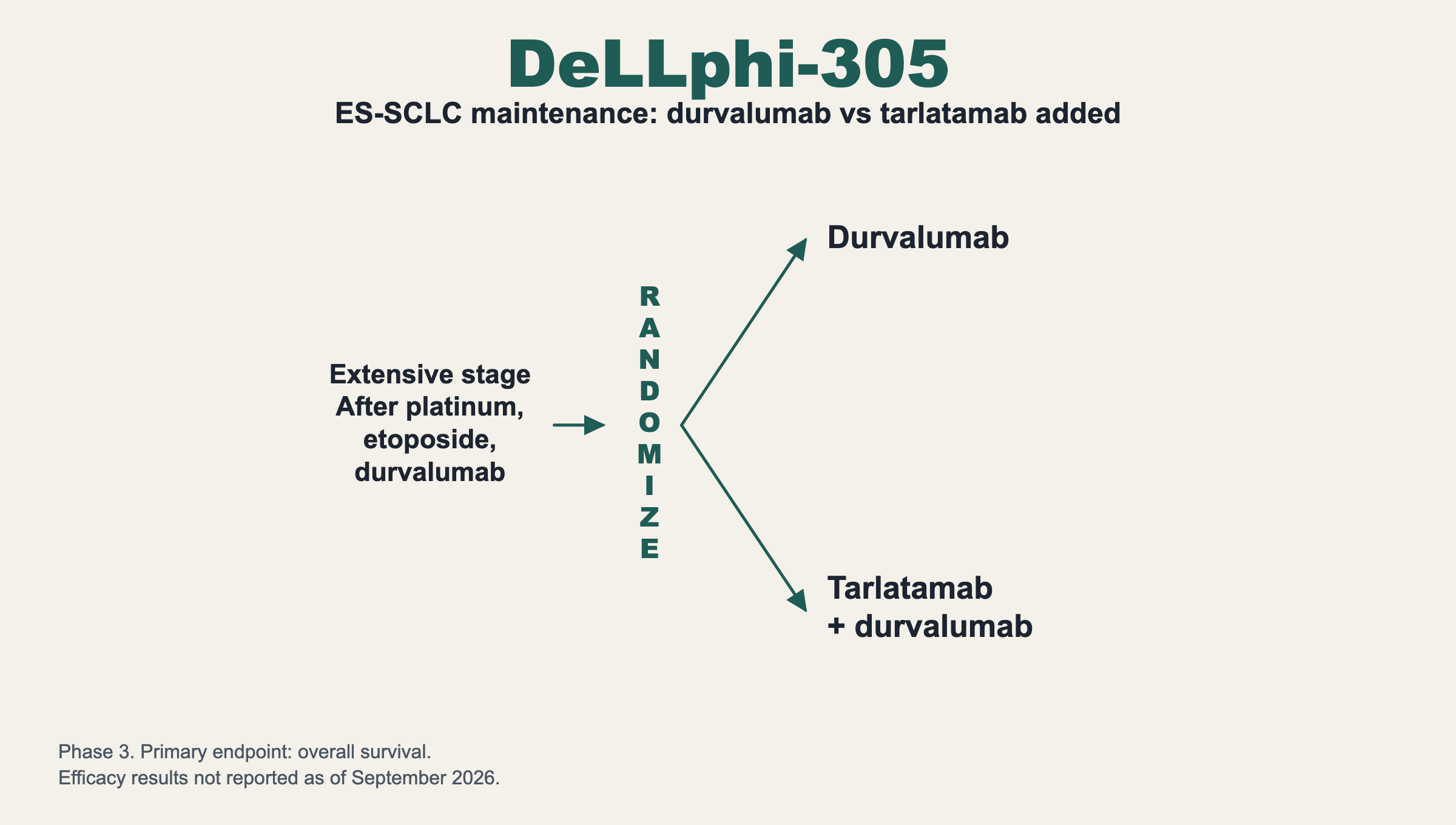
DeLLphi-305. ES-SCLC maintenance: durvalumab vs tarlatamab added

Population. Maintenance after platinum, etoposide, and durvalumab for extensive-stage small-cell lung cancer

Arms. Durvalumab vs Tarlatamab plus durvalumab

Endpoint: Overall survival

Phase 3 maintenance comparison of durvalumab alone with tarlatamab plus durvalumab after platinum, etoposide, and durvalumab. The primary endpoint is OS. Efficacy results were not reported as of September 2026.

Takeaway. No public result yet. A systemic maintenance question, with no result yet.

Paper not linked

TAISHAN-302

NCT06612151

Phase 3Practice-changingMed onc

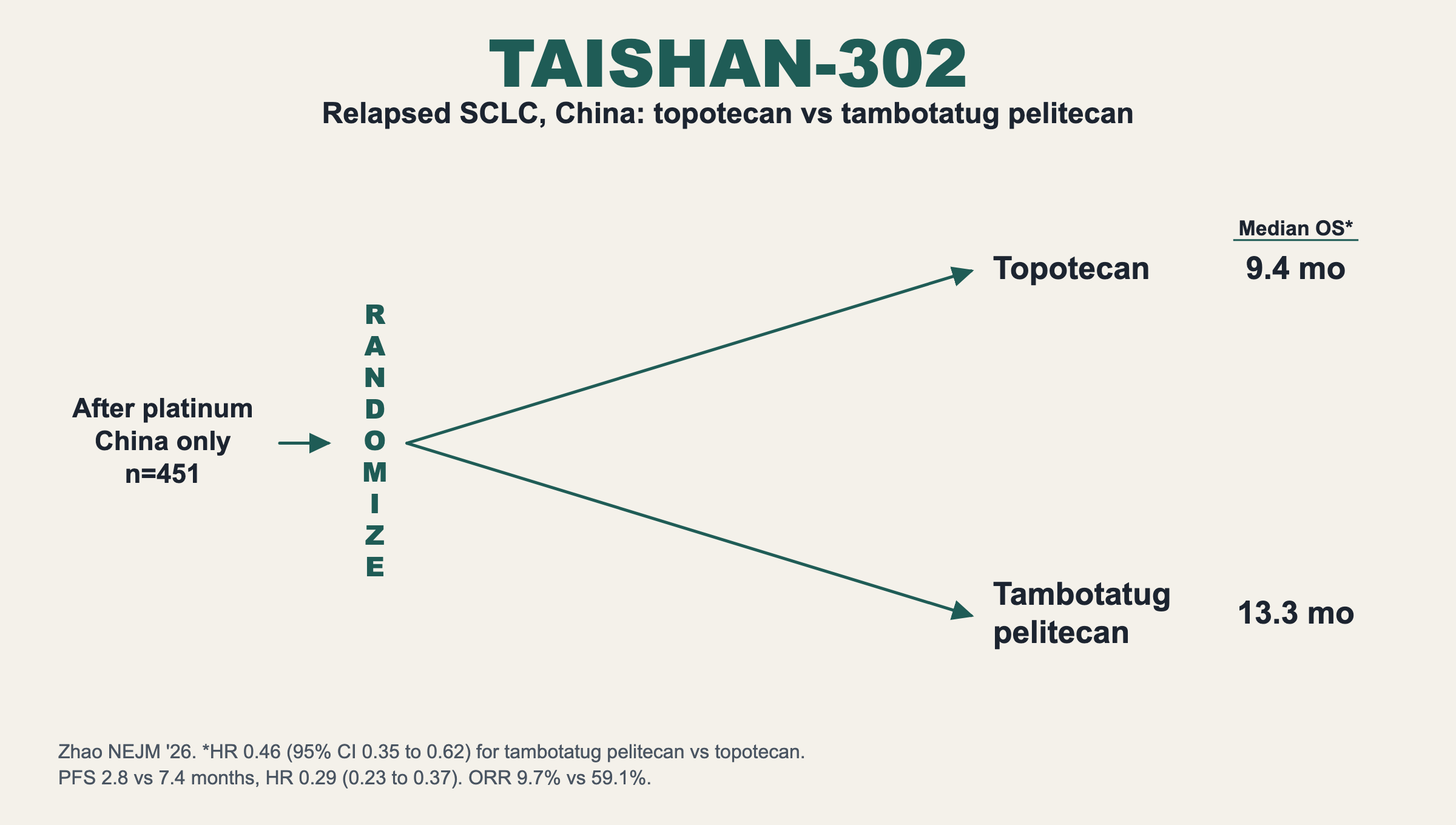
TAISHAN-302. Relapsed SCLC, China: topotecan vs tambotatug pelitecan

Population. Relapsed small-cell lung cancer after platinum, with or without a PD-L1 inhibitor

Arms. Topotecan vs Tambotatug pelitecan

Endpoint: Overall survival

Phase 3, 451 patients enrolled in China: 226 received topotecan and 225 received tambotatug pelitecan. At the May 20, 2026 cutoff, median OS was 9.4 vs 13.3 months (HR 0.46, 95% CI 0.35 to 0.62). Median PFS was 2.8 vs 7.4 months (HR 0.29, 95% CI 0.23 to 0.37), and confirmed ORR was 9.7% vs 59.1%. Hazard ratios compare tambotatug pelitecan with topotecan.

Takeaway. A large overall survival effect against topotecan. Generalization outside China is the limit. A systemic option in relapsed small-cell lung cancer.

HARMONi-2

NCT05499390

Phase 3Practice-changingMed onc

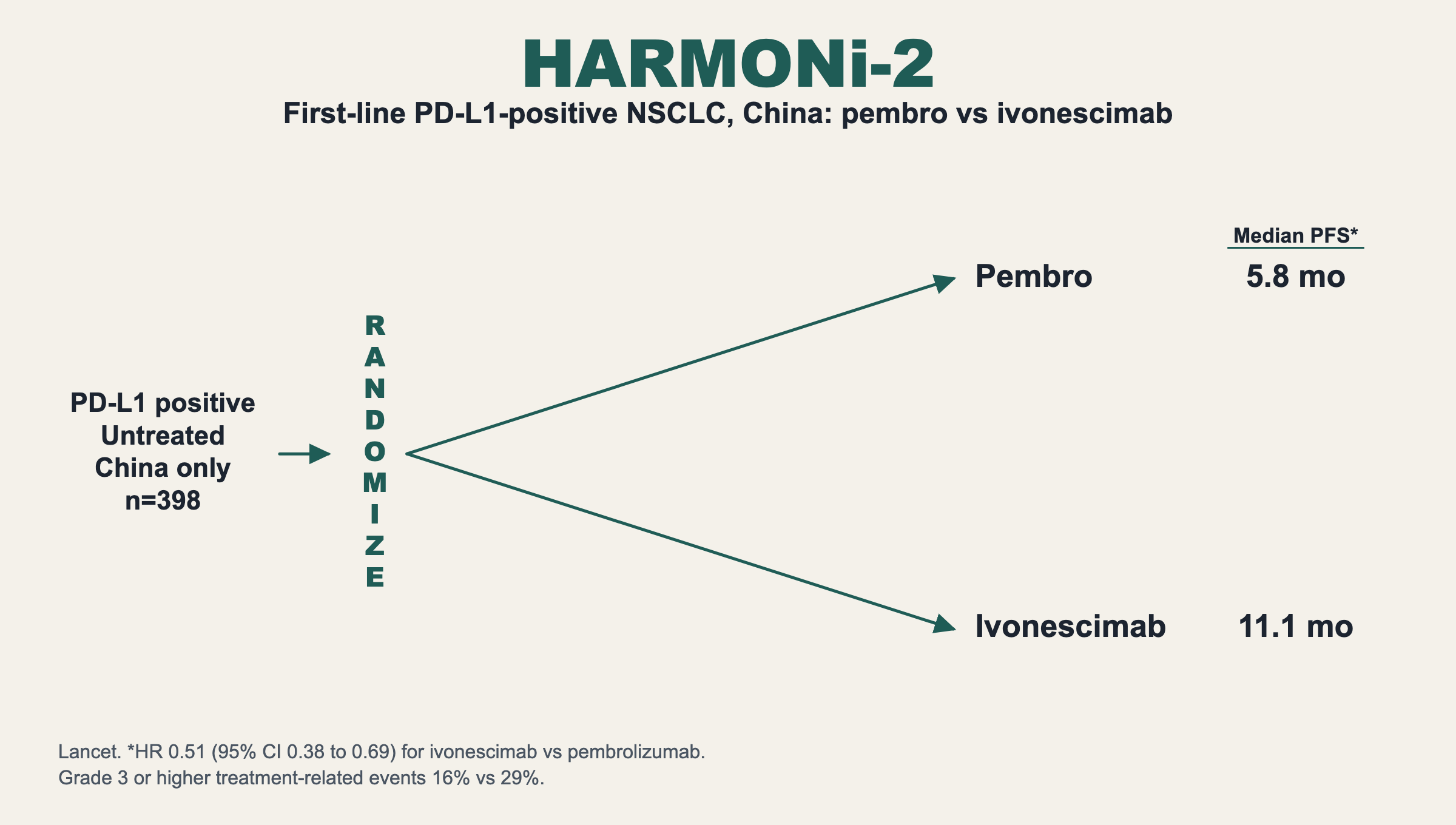
HARMONi-2. First-line PD-L1-positive NSCLC, China: pembro vs ivonescimab

Population. Untreated PD-L1-positive non-small-cell lung cancer

Arms. Pembrolizumab vs Ivonescimab

Endpoint: Progression-free survival

Phase 3, n=398, China only. Progression-free survival was 5.8 months with pembrolizumab and 11.1 months with ivonescimab (HR 0.51, 95% CI 0.38 to 0.69). Grade 3 or higher treatment-related adverse events were 16% vs 29%.

Takeaway. A phase 3 PFS win over pembrolizumab, limited by a China-only population until a global confirmatory trial reports. A first-line immunotherapy comparison.

ARTEMIS-008

NCT06498479

Phase 3Practice-changingMed onc

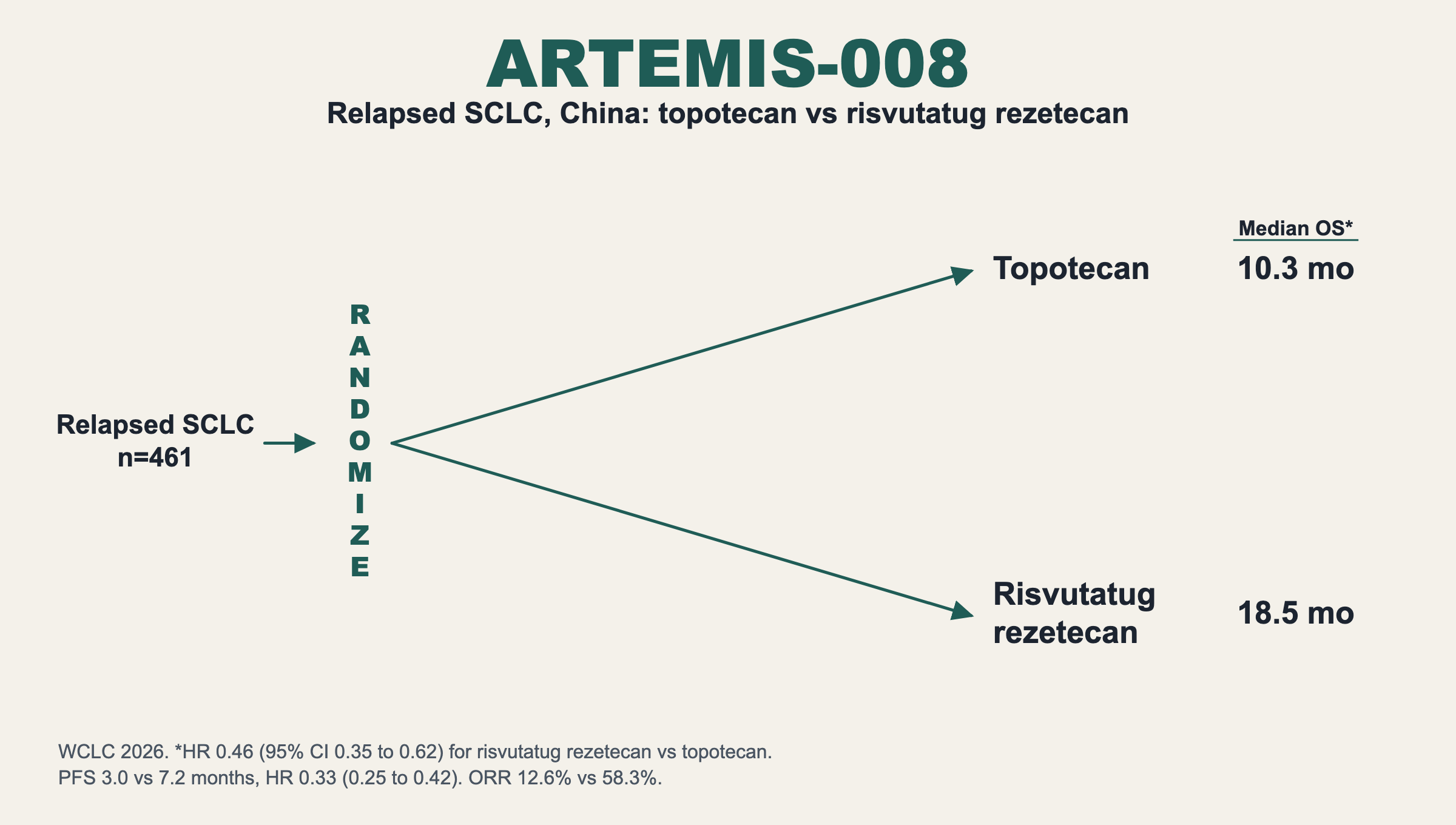
ARTEMIS-008. Relapsed SCLC, China: topotecan vs risvutatug rezetecan

Population. Relapsed small-cell lung cancer

Arms. Topotecan vs Risvutatug rezetecan

Endpoint: Overall survival

Phase 3, 461 patients enrolled in China. At the June 6, 2026 cutoff, median follow-up was 12.2 months. Median OS was 10.3 months with topotecan and 18.5 months with risvutatug rezetecan (HR 0.46, 95% CI 0.35 to 0.62). Centrally reviewed median PFS was 3.0 vs 7.2 months (HR 0.33, 95% CI 0.25 to 0.42), and ORR was 12.6% vs 58.3%. Hazard ratios compare risvutatug rezetecan with topotecan.

Takeaway. A large randomized overall survival benefit over topotecan supports a new option for relapsed SCLC, with generalizability limited by enrollment in China. A systemic antibody-drug conjugate versus topotecan in relapsed small-cell lung cancer.

KEYNOTE-D46 / EVOKE-03

NCT05609968

Phase 3Practice-informingMed onc

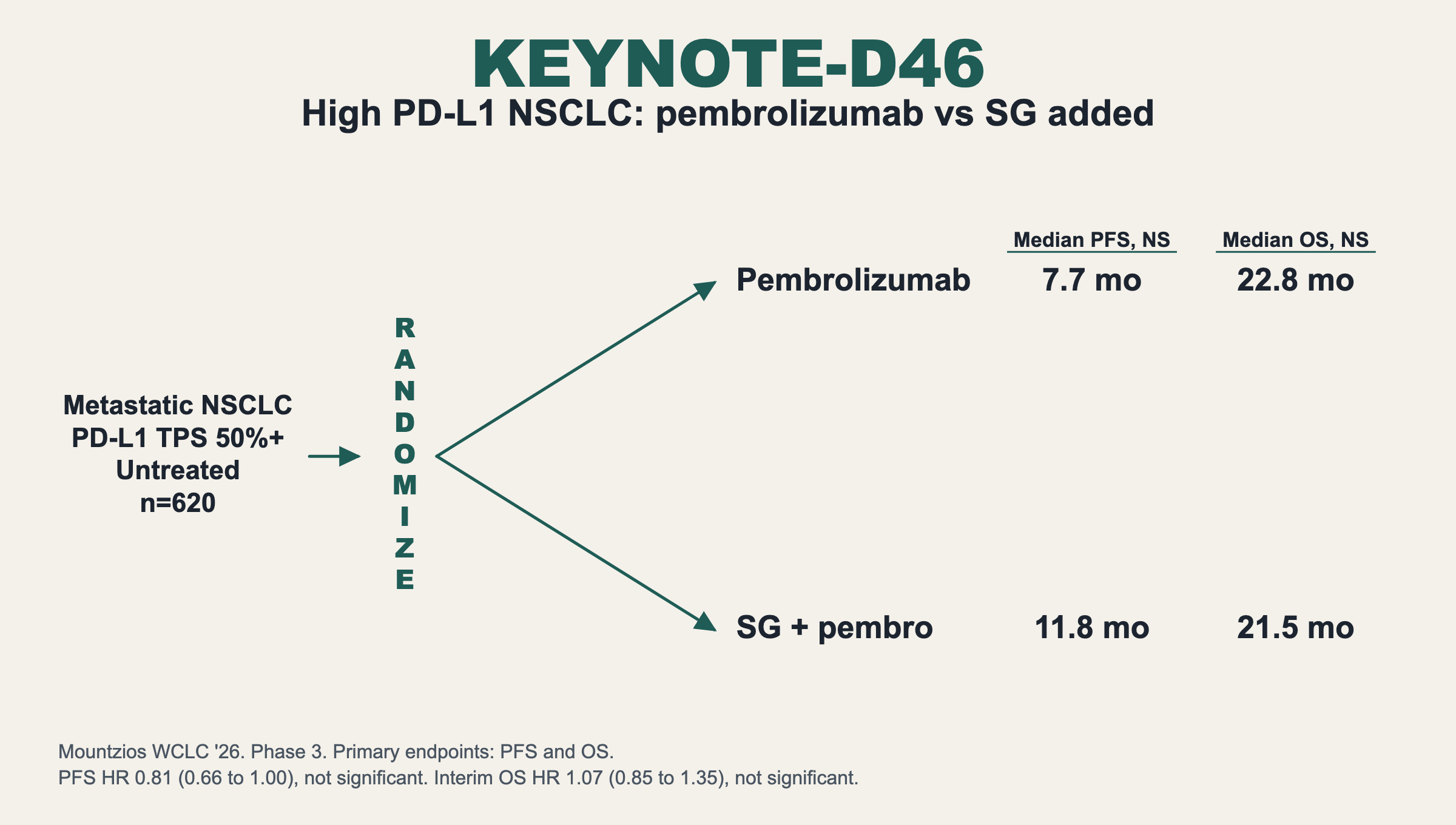
KEYNOTE-D46. High PD-L1 NSCLC: pembrolizumab vs SG added

Population. Untreated metastatic non-small-cell lung cancer, PD-L1 TPS at least 50%

Arms. Pembrolizumab vs Sacituzumab govitecan plus pembrolizumab

Endpoint: Progression-free survival and overall survival

Phase 3, n=620. Median PFS was 7.7 months with pembrolizumab and 11.8 months with sacituzumab govitecan plus pembrolizumab (HR 0.81, 95% CI 0.66 to 1.00; p=0.0252), not significant at the prespecified threshold. Interim median OS was 22.8 vs 21.5 months (HR 1.07, 95% CI 0.85 to 1.35; p=0.7155), not significant. Hazard ratios compare the combination with pembrolizumab.

Takeaway. The combination did not significantly improve PFS or interim OS and increased severe treatment-related toxicity. A first-line antibody-drug conjugate added to pembrolizumab.

ADAURA

NCT02511106

Phase 3Practice-informingMed oncSurg oncRad onc

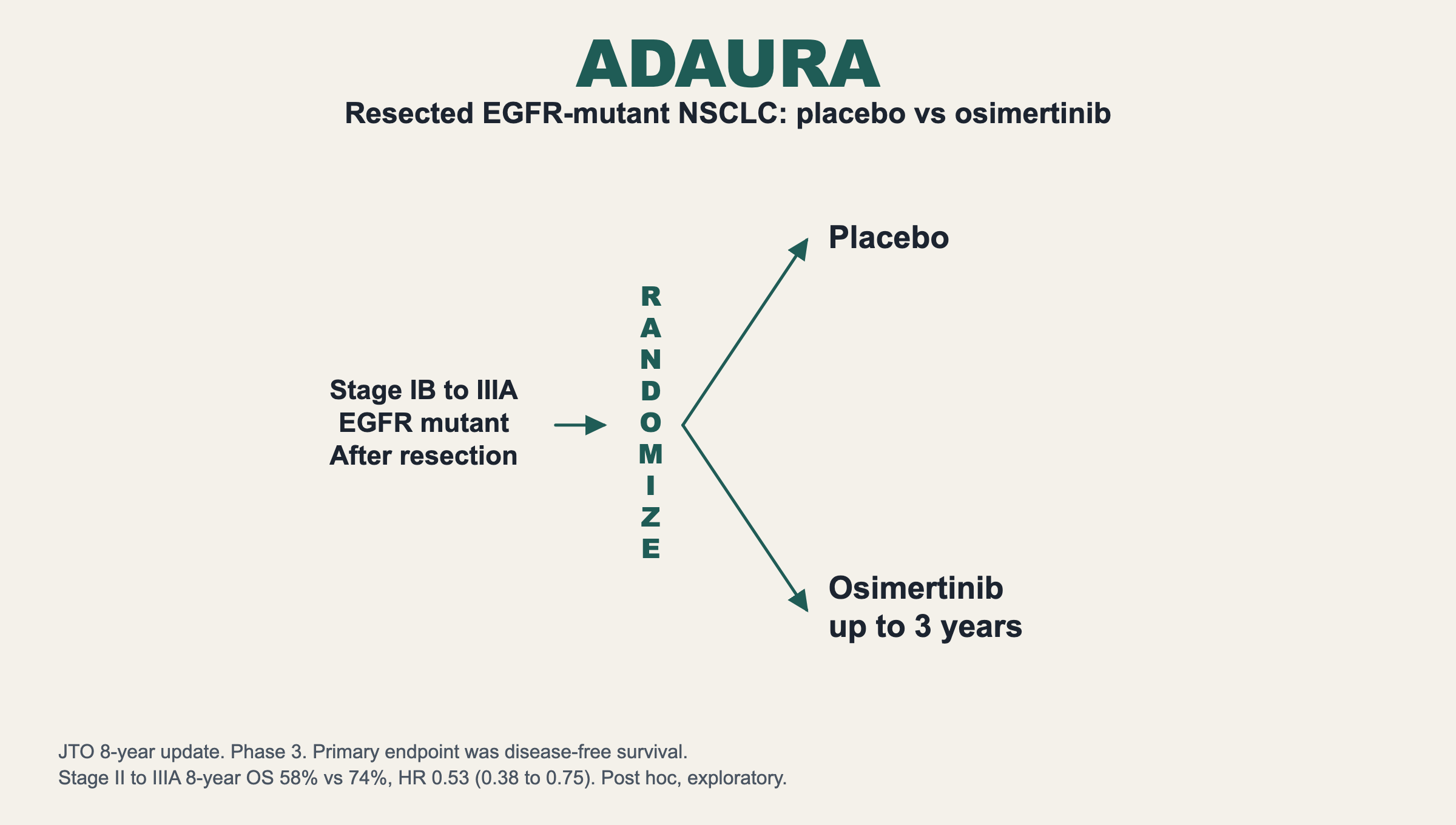
ADAURA. Resected EGFR-mutant NSCLC: placebo vs osimertinib

Population. Resected stage IB-IIIA EGFR-mutant non-small-cell lung cancer

Arms. Placebo vs Adjuvant osimertinib for up to 3 years

Endpoint: Disease-free survival

Phase 3 trial, n=682, with a post hoc exploratory eight-year OS update. In stage II to IIIA disease, eight-year OS was 58% with placebo and 74% with osimertinib (HR 0.53, 95% CI 0.38 to 0.75). Across stage IB to IIIA disease, OS was 64% vs 79% (HR 0.52, 95% CI 0.39 to 0.71). This supports the durability of an established standard.

Takeaway. Confirms the existing standard of adjuvant osimertinib after resection of eligible EGFR-mutant NSCLC. The exploratory long-term update supports durability of benefit rather than changing the treatment choice. Adjuvant osimertinib after resection is a medical oncology prescription. The long-term surgical result is part of the operation-versus-SBRT conversation. Long-term surgical outcomes inform SBRT-versus-surgery discussions in operable early-stage disease.

Likely practice-changing this month

  • MAVERICK / SWOG S1827 (Lung): A phase 3 de-escalation result that challenges routine PCI. The survival interval is still too wide to call no survival cost established.
  • DESTINY-Lung04 (Lung): First positive phase 3 on PFS in first-line HER2-mutant NSCLC, with an overall survival hazard ratio above 1 and a one-in-five ILD rate.
  • TAISHAN-302 (Lung): A large overall survival effect against topotecan. Generalization outside China is the limit.
  • PACE-A (GU): Not a superiority claim. It is the first phase 3 to show long-term cancer control in the same range as prostatectomy, with a large urinary-function gap favoring SBRT.
  • HARMONi-2 (Lung): A phase 3 PFS win over pembrolizumab, limited by a China-only population until a global confirmatory trial reports.

Most relevant to a medical oncologist

  • RMC-6236-001 (Lung): An early systemic RAS inhibitor signal, not a phase 3 result.
  • DESTINY-Lung04 (Lung): A first-line systemic choice in HER2-mutant lung cancer.
  • DeLLphi-305 (Lung): A systemic maintenance question, with no result yet.
  • TAISHAN-302 (Lung): A systemic option in relapsed small-cell lung cancer.
  • GlutaPanc / IIT2020-02 (GI): A first-line systemic combination, still a dose-finding study.

Most relevant to a surgical oncologist

  • PACE-A (GU): Prostatectomy is one of the two arms.
  • ADAURA (Lung): The long-term surgical result is part of the operation-versus-SBRT conversation.
  • VOLGA (GU): Cystectomy is the control, so this changes who is offered surgery.
  • LAVA-CRLM (GI): Ablation versus SBRT is a local-therapy choice surgical oncology shares.
  • MATTERHORN (GI): This is a resectable gastric cancer question, decided before the operation.

Most relevant to a radiation oncologist

  • MAVERICK / SWOG S1827 (Lung): This is the PCI decision.
  • DESTINY-Lung04 (Lung): A 20.8% drug-related ILD rate changes the risk of thoracic radiotherapy around T-DXd.
  • PACE-A (GU): Directly changes the surgery-versus-SBRT conversation for operable localized prostate cancer.
  • ADAURA (Lung): Long-term surgical outcomes inform SBRT-versus-surgery discussions in operable early-stage disease.
  • RTOG 0534 / SPPORT (GU): Pelvic nodal coverage and short-term ADT in the salvage setting are day-to-day rad onc decisions.